Armored guardians of the German coast
Heavy guns, shallow draft and compact dimensions produced ships intended to defend naval bases and strategic approaches in the North Sea and Baltic.
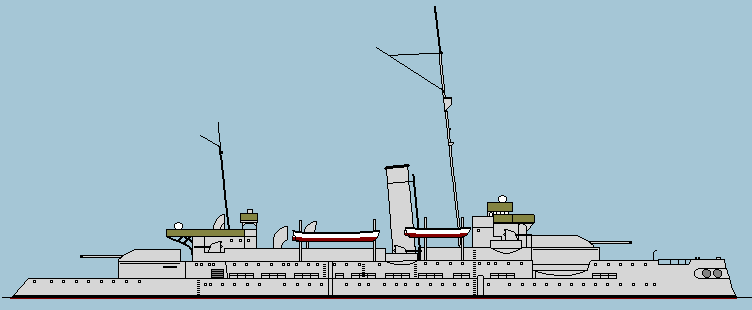
Design and service
The coast defence ships of the Siegfried class were the first real capital warships build in Germany and the last before Kaiser Wilhelm II came into power and started the huge naval construction program. With their three 24 cm guns, those ships were not armed very heavily, but they were the first German warships that carried their main artillery in closed gun turrets. The last two ships of the class, Odin and Ägir had some minor modifications and different armor protection, but besides that, all eight ships were very similar. Because of their rolling movements through the seas, those ships got the nickname "Meerschweinchen" - guinea-pig.
Shortly after the beginning of the new century, all ships were modified in a major reconstruction, a second funnel and enlarged hull were the most obvious changes, and with their new coal storage's, their range was almost doubled. During World War I, those old ships were still used for coastal defence, and all of them survived the war. As they were too old for further military services most of them were scrapped while a few were converted in to civilian transport ships.
When the Hildebrand was sold to be scrapped in 1919 after an almost identical history than its sister ships, the ship beached on its way to a scrap yard in the Netherlands. The wreck was blown up in 1933.
Operational history
Hildebrand begins its trials. The trials had to be stopped because of boiler problems.
Used as guard ship in Kiel, followed by repairs.
Recommissioned.
Attached to the North Sea Reserve Division.
Participation in the autumn fleet maneuvers.
Trials in the Baltic Sea.
Used as in the North Sea Reserve Division in Wilhelmshaven.
Participation in the autumn fleet maneuvers.
Decommissioned.
The ship is recommissioned for participation in the autumn fleet maneuvers.
Decommissioned.
Recommissioned.
After the autumn fleet excercises, the ship is decommissioned.
Recommissioned.
After the autumn fleet excercises, the ship is decommissioned.
Recommissioned.
Voyage to Norway.
Participation in the autumn fleet maneuvers.
Decommissioned in Danzig, prepeared for reconstruction.
The ship's hull is cut into two pieces and a new midship section is inserted.
Hildebrand is recommissioned.
Used as Flagship of the II. Squadron.
Autumn fleet excercises.
Fleet excercises.
Flagship of the re-formed II. Squadron.
Autumn fleet excercises.
Decommissioned in Danzig.
Recommissioned, attached to the 3rd Sqaudron formed by the coast defense ships.
Decommissioned in Danzig.
Recommissioned after the outbreak of the war, attached to the 6th squadron formed by the coast defense ships Heimdall, Hildebrand, Hagen, Frithjof, Aegir, Odin, Beowulf and Siegfried.
Sent to Kiel.
Coast defence operations with the VI. Squadron in the German Beight.
Standby for the fleet operation to Yarmouth and Lowestroft.
Hildebrand assists the coast defence ship Hagen which had run aground.
While trying to assit the Answald, the Hildebrand runs aground, too and could only be saved the next day.
Repairs in Wilhelmshaven.
Coast defence operations with the VI. Squadron in the German Beight.
Sent to Kiel.
Decommissioned.
Used as a floating barrack in Libau and Windau.
Stricken form fleet list and sold to the Netherland for scrap.
Being towd to the Netherlands, the ship beaches during a storm near Scheveningen.
Wreck is broken down.
At a glance
Dimensions, armament, protection and performance.
Construction record