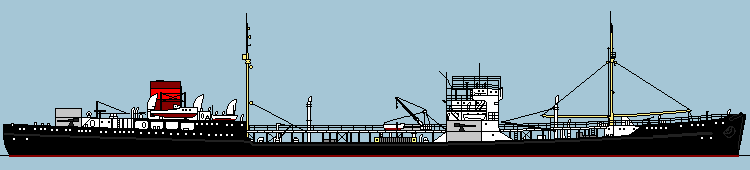
Supply operations for Kriegsmarine ships during the sea control in the Spanish Civil War.
1939–1960Service period
20,858 tMaximum displacement
SouthmarkBritish name
USS ConecuhUS Navy name
Design and service
The story of Dithmarschen
Germany had no overseas naval bases, so operations in the North Atlantic depended on a network of supply ships and tankers known as Troßschiffe. The Kriegsmarine practiced replenishment at sea from the mid-1930s and used it extensively during the Spanish Civil War. In spring 1939, several warships and supply vessels, including the battlecruiser Gneisenau, conducted a major exercise in the central Atlantic that rehearsed methods used repeatedly during the next two years.
The use of supply ships reached its peak in May 1941 during Operation Rheinübung, the only operation of the battleship Bismarck. After Bismarck was lost, the Royal Navy hunted down and sank many of the German supply vessels positioned across the Atlantic.
Alongside converted civilian tankers, the Kriegsmarine ordered the purpose-built Dithmarschen class. Nine ships were planned but only five entered service. They could transfer fuel, ammunition, provisions and spare parts, and carried towing equipment to assist damaged warships. Their payload comprised 7,933 t of fuel, 972 t of ammunition, 790 t of provisions and 100 t of spare parts.
The ships were initially considered for use as auxiliary cruisers, but the plan was abandoned because combat damage would have endangered their vulnerable cargoes. Two members of the class survived the war and continued in British and American service into the 1950s.
Dithmarschen supported German forces during Operation Juno in June 1940, but engine trouble and a grounding disrupted two planned Atlantic supply missions later that year and in early 1941. After further service in Norway, the ship was captured at Bremerhaven in May 1945. It passed first to Britain as Southmark and then to the United States, entering service as USS Conecuh in 1946. The former fleet tanker remained in American service until 1956 and was struck from the register in 1960.
Operational history
Service timeline
After several months of repairs and refits, the Dithmarschen enters Kriegsmarine service again.
Supply operation during Operation Juno.
Dithmarschen is scheduled for supply operations for Panzerschiff Admiral Scheer, but because of an engine breakdown the ship has to return to France.
The Troßschiff is scheduled for supply operation for battlecruisers Scharnhorst and Gneisenau but runs aground when leaving France.
Repairs.
Supply operations for Kriegsmarine ships in Norway.
Dithmarschen is taken over by British troops in Bremerhaven, renamed to Southmark.
Taken over by US Navy.
Enters operational service in the US Navy.
Renamed to Conecuh.
Transferred to the reserve fleet.
Stricken from service, scrapped after that.
At a glance
Technical profile
Key dimensions, armament, machinery and performance.
Dimensions
- Size (maximum)
- 20,858 t
- Length (total)
- 178.25 m
- Length (waterline)
- 174.65 m
- Beam
- 22.00 m
- Draft
- 9.30 m
- Crew
- 94–208
Armament
- 15 cm L/48 C36
- 3
- 3.7 cm Flak
- 2
- 2 cm Flak
- 4
- Machine guns
- 8
Machinery
- Shafts
- 2
- Engines
- 4
- Type
- MAN 9-cylinder diesels
Performance
- Total power
- 22,000 shp
- Speed
- 21.1 kn
- Range
- 12,500 nm at 15 kn
Construction record
Dithmarschen
- Laid down
- Schichau, Danzig · 06.06.1936
- Launched
- 12.06.1937
- Commissioned
- 20.07.1939
- Fate
- Scrapped after 1960