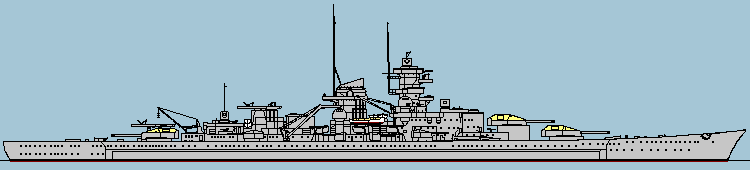
Commissioned, after that training and trials.
229,8 m (234,9 m since 1939)Overall length
38900 tMaximum displacement
30,7 knMaximum speed
1669 - 1840Complement
Design and service
The story of Gneisenau
After the construction of the first three Panzerschiffe (Panzerschiff A-C: Deutschland, Admiral Scheer and Admiral Graf Spee) various plans for their successors were made. Projects ranged from only slightly modified designs, increased main artillery (like 30 cm guns), ships that later could refitted with a third turret or Panzerschiffe with steam engines. The developers first weren't allowed to increase the size of the ships, so all projects sooner or later lead into a quite similar design as the older Panzerschiffe.
Only after a significant grow in size was allowed, the final development of the Scharnhorst class started. Although often called "battlecruisers", those ships were officially labeled as "battleships". In difference to the Panzerschiffe a high-pressure steam engine was chosen for these ship to give them a much higher speed but since those engines never worked without any problems later operations were often negatively influenced by them.
Their main artillery was increased by 50%, but unlike other foreign battleships, the Scharnhorst class got only the small caliber guns of the Panzerschiffe. The decision for those guns was made because those guns were already in production and at this time no bigger gun was developed. To complete the ships in the planned time, the 28cm (11") guns had to be used.
But the construction of the turret mountings allowed it to replace the 28cm triple turrets with 38 cm (15") twin turrets. It was planned to do this conversion after the construction of the next generation of battleships (Battleship F & G) in 1940, but the start of the war prevented this. Battleship D, later called Scharnhorst, was laid down in May 1935 at the Kriegsmarine Shipyard in Wilhelmshaven and commissioned in January 1939.
The sister ship Gneisenau (Battleship E) was laid down in March 1935 at the Deutsche Werke in Kiel and commissioned in May 1938. It soon became clear that the straight bow of the ships had to be modified because of the amount of water taken over at high speed. During the war, both ships operated together most time.
They did a successful North Atlantic operation, and were the only battleships that sink a operational fleet carrier. After heavy bomb damages, the Gneisenau should get the projected 38 cm guns, but after the battle in the Barents Sea at the end of 1942 all work on major ships was canceled. The original 28 cm guns were used as coastal batteries: Guns of the destroyed Turret Anton were set up as single mounting at the Hook van Holland near Rotterdam, Turret Bruno was installed at Fjett outside of Bergen as Batterie "Fjell" and was cut to scrap in 1968.
Turret Cäsar was mounted at Lundahaugen at Austraatt in the mouth of the Trondheim fjord. It is still existing as a museum today. Two of the 15 cm gun turrets are still in active service at the Danish coastal fortress at Stevns, this fortress is due to close in theyear 2000.
Operational history
Service timeline
Battle training in the North Atlantic.
Gneisenau becomes flagship of the Kriegsmarine.
Raid to intercept Britain - Scandinavia trade together with CL Köln and destroyers Wilhelm Heidkamp, Friedrich Ihn, Diether von Roeder, Karl Galster, Max Schulz, Paul Jakobi, Bernd von Arnim, Erich Steinbrinck and Friedrich Eckoldt. No results.
Together with Scharnhorst, the Gneisenau is sent south of Iceland to attack the Northern Patrol.
The two battlecruisers sink the British auxiliary cruiser Rawalpindi.
Gneisenau suffered severe sea damage during a heavy storm in the Shetland-Bergen Narrows.
Returns to Kiel.
Repairs completed, ship transfers to Wilhelmshaven.
Operation "Nordmark": Scharnhorst, Gneisenau, CA Admiral Hipper and the destroyers Wolfgang Zenker, Wilhelm Heidkamp and Karl Galster are sent to intercept British convoys between Bergen and England, but no ships are sighted.
Operation "Weserübung": Flagship of the fleet commander Vice-Admiral Lütjens. Battle with British BC Renown and cruiser Birmingham west of the Lofoten, Gneisenau was hit once.
Returns to Wilhelmshaven.
On its way from Wilhelmshaven to the Baltic Sea, the Gneisenau is hit by a mine.
Operation "Juno": Flagship in the Polar Sea operations together with Scharnhorst, Admiral Hipper and the destroyers Karl Galster, Hans Lody, Erich Steinbrinck and Hermann Schoemann.
Battle with British CV Glorious and the DDs Ardent and Acasta. All British ships are sunk.
Returns to Drontheim.
Sailed into the Polar Sea with Admiral Hipper. Operations canceled, ships return to Drontheim again.
Leaves Drontheim with Admiral Hipper again for operations between Iceland, the Faroers and Orkney. 40 nautical miles north-west of the island of Halten, Gneisenau is hit by a torpedo of the British submarine Clyde. Emergency repairs at Drontheim.
Escorted by CL Nürnberg, the Gneisenau leaves Drontheim to return to Kiel.
Arrives at Kiel.
In dock.
Abandoned attempt to break out into the North Atlantic together with Scharnhorst. Gneisenau suffered storm damage.
Operation "Berlin": Second successful attempt to break out into the North Atlantic together with sister ship Scharnhorst.
Reached southern Greenland.
Unsuccessful attack on convoy HX-108 after the sighting of the BB Ramiles.
Scharnhorst and Gneisenau sink four merchants east of Newfoundland.
Attack on convoy SL-67 is broken off as the British BB Malaya is sighted. Two U-boats are ordered to attack the convoy and sink 5 merchants.
Scharnhorst and Gneisenau sink 16 merchants east of Newfoundland. Gneisenau is sighted by the British BB Rodney which requests identification of the German ship. Gneisenau replies "H.M.S. Emerald " and escapes.
Both ships enter Brest. They sunk a total of 22 ships with 115600t, Gneisenau 14 with 66300 t.
Hit by aircraft torpedo, put into dock.
The ship is hit by four bombs during British bomber attacks on Brest.
Operation "Ceberus": Break through the English Channel: Scharnhorst, Gneisenau and CA Prinz Eugen, escorted by 6 destroyers (Paul Jakobi, Richard Beitzen, Friedrich Ihn, Hermann Schoemann, Z25, Z29) and 14 torpedo boats (e.g. Kondor, Jaguar, T12, T13), return to Germany. Gneisenau is hit by a mine on the Brunsbüttel Roads on its way to Kiel.
In the night of the 26th to 27th, Gneisenau is hit by a large bomb during an air attack. The complete bow section burns out and takes the ship out of action.
Sent to Gotenhafen (Gdynia) to be decommissioned and reconstructed.
Withdrawn from service. The 28 cm (11") triple turrets should be replaced with 38 cm (15") twin turrets.
After the sinking of the Scharnhorst, conversion work is stopped.
Sunk as a blockade ship in Gotenhafen (Gdynia).
Broken up and scrapped.
At a glance
Technical profile
Dimensions, armament, protection and performance.
Dimensions
- Size (Max)
- 38900 t
- Length (Total)
- 229,8 m (234,9 m since 1939)
- Length (Waterline)
- 226,0 m
- Beam
- 30,0 m
- Draft
- 9,9 m
- Crew
- 1669 - 1840
Armament
- 28 cm L/51 C/34 (11")
- 9
- 15 cm L/55 C28
- 12
- 10,5 cm L/65 C/33
- 14
- 3,7 cm L/83
- 16
- 2 cm MG L/64
- 10
- 53,3 cm Torpedoes
- 6
Aircraft
- Arado Ar 196
- 3
Protection
- Deck
- 80-95 mm
- Belt
- 350 mm (max)
- Command Tower
- 350 mm (max)
- Turrets
- 360 mm (max)
Machinery
- Shafts
- 3
- Turbines
- 3
- Type
- Krupp Germania
Performance
- Total Performance
- 153897 shp
- Speed
- 30,7 kn
- Range
- 8380 miles at 15 kn
Design study
Reconstruction
The planned reconstruction would have lengthened Gneisenau and replaced the nine 28 cm guns with six 38 cm guns in twin turrets.
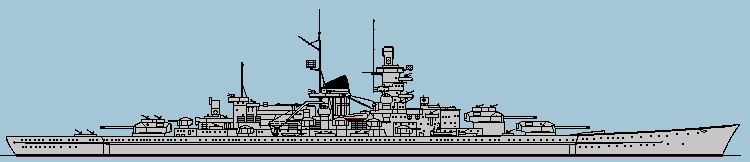
Dimensions
- Size (Max)
- 43000 t
- Length (Total)
- 245,0 m
- Length (Waterline)
- ~ 230,0 m
- Beam
- 30,0 m
- Draft
- 10,6 m
- Crew
- 1669 - 1840
Armament
- 38 cm L/47 C/34 (15")
- 6
- 15 cm L/55 C28
- 12
- 10,5 cm L/65 C/33
- 14
- 3,7 cm L/83
- 16
- 2 cm MG L/64
- 10
- 53,3 cm Torpedoes
- 6
Aircraft
- Arado Ar 196
- 3
Protection
- Deck
- 80-95 mm
- Belt
- 350 mm (max)
- Command Tower
- 350 mm (max)
- Turrets
- 360 mm (max)
Machinery
- Shafts
- 3
- Turbines
- 3
- Type
- Krupp Germania
Performance
- Total Performance
- 153897 shp
- Speed
- 30,7 kn
- Range
- 8380 miles at 15 kn
The archive
Photographs
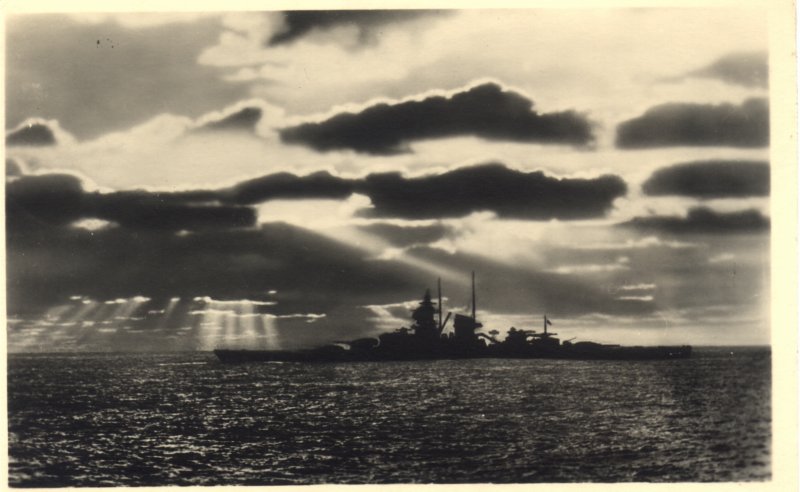
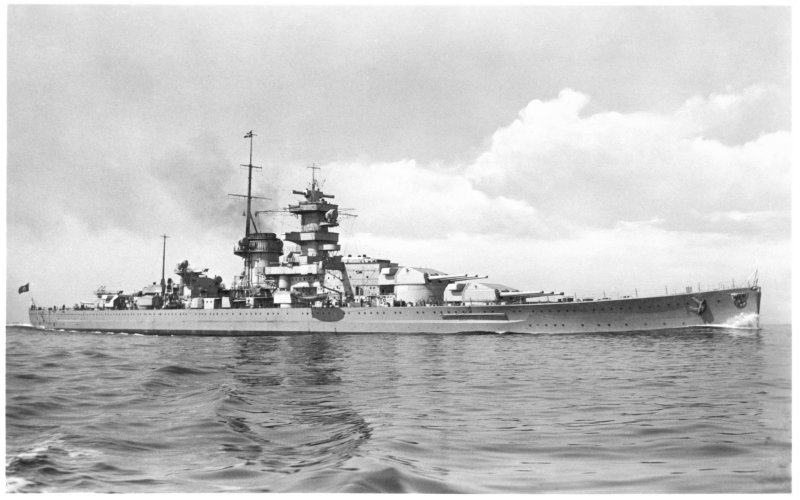
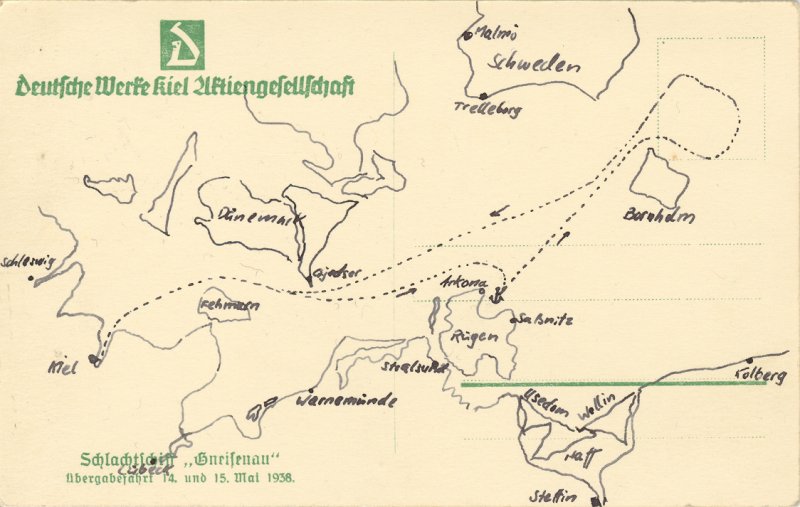
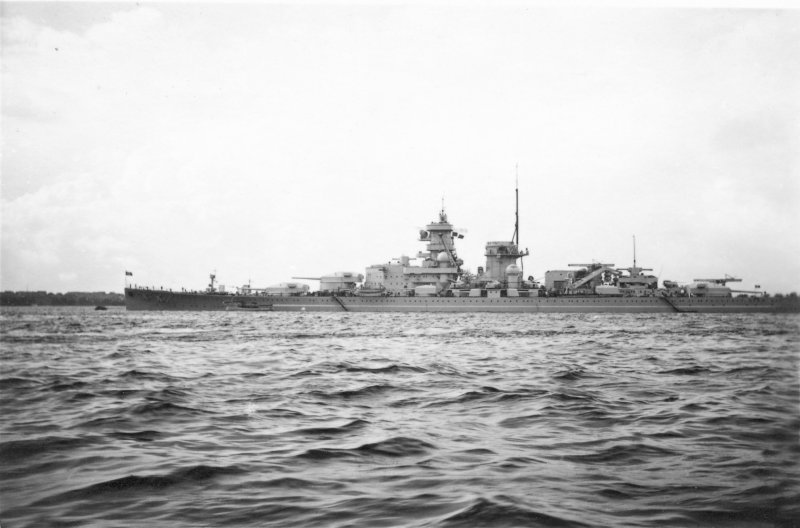
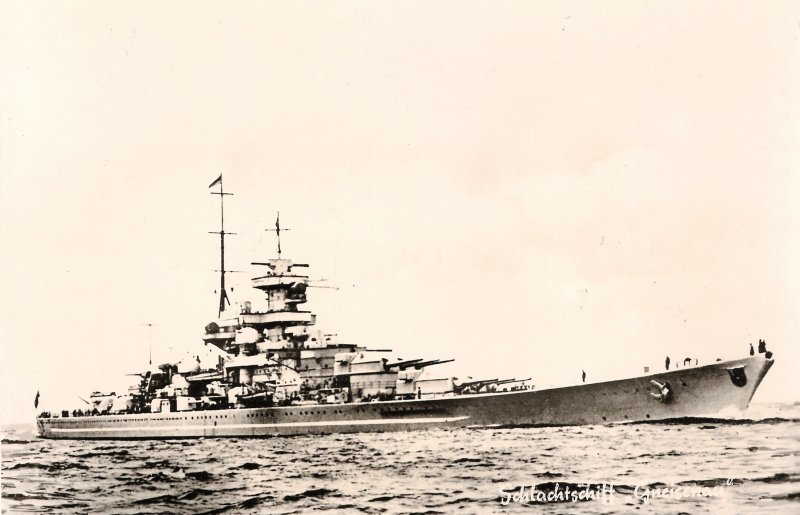
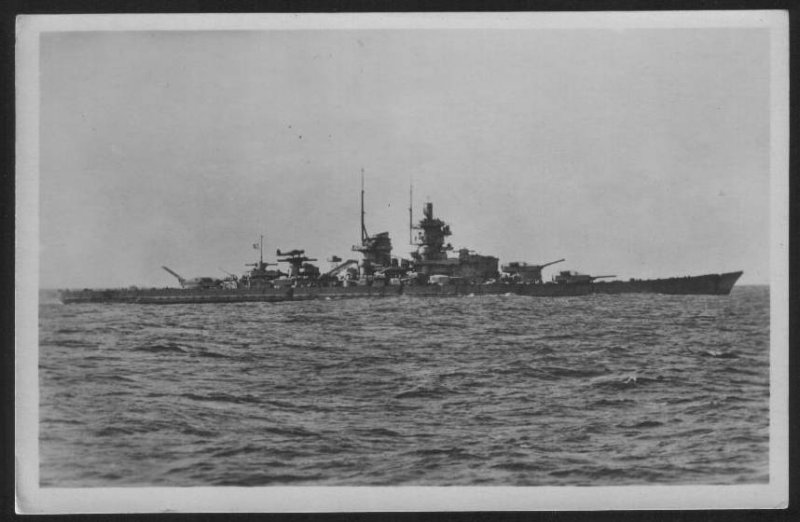
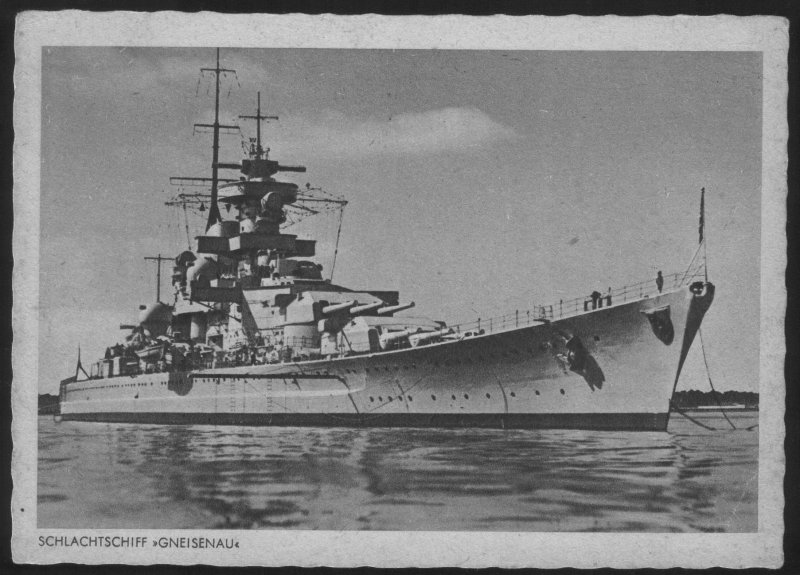
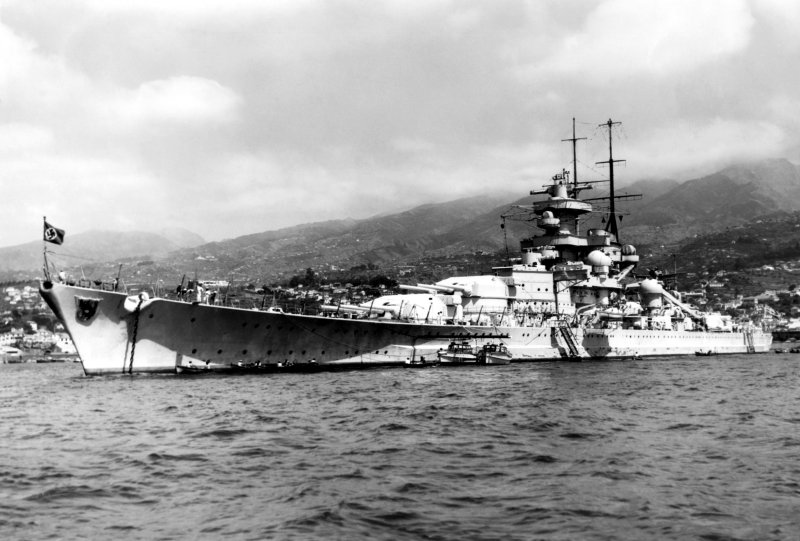
Original postcard and photographic material from the private collection.
The archive
Models
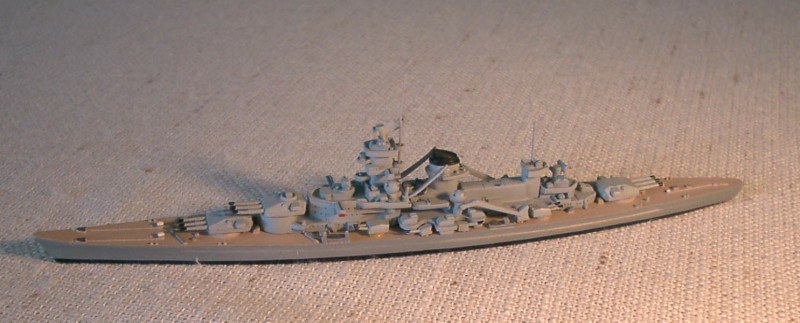
Ship models in 1/1250 scale.
Construction record
Gneisenau
- Laid down
- Deutsche Werke Kiel, 06.05.1935 (Slipway 1)
- Launched
- 08.12.1936
- Commissioned
- 21.05.1938
- Fate
- sunk as a blockade ship March 1945 (Gotenhafen /Gdynia)
- Cost
- 146 Mio Reichsmark