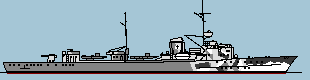
T6, T7, T8 and T10 escort the Panzerschiff Admiral Scheer from Brunsbüttel to Bergen.
84,30 mOverall length
1082 tMaximum displacement
35,0 knMaximum speed
119Complement
Design and service
The story of Torpedoboot T10
After operations near Jutland and mining operations in the North Sea, T10 was sent to France in September 1940 for a short time. After a short visit in Germany, the 2st Torpedoboot Flotilla was relocated to Norway, some of those ships supported the advance of German troops during the invasion of the Soviet union and some participated in Operation Cerberus in 1942. The remaining ships were was part of the torpedo training school in the Baltic Sea until mid 1943.
From 1944, the 2nd Torpedoboot Flotilla was used for escort duties in the Baltic Sea. T10 was destroyed by British bombs on 18 December 1944 while being docked in Gotenhafen (Gdynia) for repairs.
Operational history
Service timeline
Operation of the 1st and 2nd torpedo boat flotilla with T1, T4, T6, T7, T8, T9 and T10 against coastal shipping at the British east coast. The operation is cancelled after T6 is sunk after a mine hit near Aberdeen.
The torpedo boats Falke, Greif, Seeadler, T1, T7, T9, T10 and T12 escort the battleships Scharnhorst and Gneisenau during their attempt to break into the North Atlantic. The operation is aborted.
Escorted by the torpedo boats T1, T5, T9 and T10, the mine layers Brummer, Königin Louise and Tannenberg leave Stavanger to lay the mine field "20 Pommern". The operation is aborted due to the weather conditions.
Another attempt to lay the mine field "20 Pommern": T1, T5, T10 and T12 escort several mine layers, again the operation has to be aborted because of the weather.
Falke, T5, T9 and T10 escort the battleships Scharnhorst and Gneisenau on their way into the Atlantic.
Mine laying operation "22 Rügen" of the mine layers Brummer, Königin Luise and Tannenberg. The mine layers are escorted by the torpedo boats Falke, T5, T9, T10 and T12.
T9 and T10 are lightly damaged during an air attack on the Deutsche Werke shipyard in Kiel.
Decommissioned.
T4, T10, T13 and T14 are sent to Le Havre.
Mine laying operations of the 3rd torpedo boat flotilla consisting of T4, T10, T13 and T14 in the British Channel.
Mine laying operation of T10, T13 and T14 in the British Channel.
T10, T13 and T14 escort the tanker Uckermarck from La Pallice to the Biscay.
T4 and T10 escort the support ships Uckermarck and Ermland between Royan and Pallice.
Unsuccessfull attempt of the support ship Uckermarck to break out into the Atlantic. The ship is escorted back to La Pallice by T4, T10, T13 and T14.
On a third attempt, T10, T13 and T14 escort the support ship Uckermarck to the Biscay.
T10, T13 and T14 escort the frighter Spichern from the Biscay to St. Nazaire.
T4, T10 and T14 escort the support ship Lido in the Biscay.
T4, T10, T14 and T19 escort the auxiliary cruiser Komet through the Channel. THe ships are attacked by 9 British escort vessels and 8 British MTB. Komet is sunk after a torpedo hit, the torpedo boats return to Brest.
At a glance
Technical profile
Dimensions, armament, protection and performance.
Dimensions
- Size (Max)
- 1082 t
- Length (Total)
- 84,30 m
- Length (Waterline)
- 82,16 m
- Beam
- 8,62 m
- Draft
- 2,94 m
- Crew
- 119
Armament
- 10,5 cm L/45 C/32
- 1
- 3,7 cm MG
- 2 (snice 1944)
- 2 cm MG L/65 C/39
- 5-12
- 53,3 cm Torpedo tubes
- 6 (3 since 1944)
- Mines
- 30
Machinery
- Shafts
- 2
- Turbines
- 2
- Type
- Wagner Geared Turbines
Performance
- Total Performance
- 31000 shp
- Speed
- 35,0 kn
- Range
- 1070 sm at 19 kn
Construction record
Torpedoboot T10
- Laid down
- Schichau Elbing, 24.11.1936
- Launched
- 06.08.1940
- Commissioned
- 06.08.1940
- Fate
- destroyed 18.12.1944
- Cost
- 8,8 Mio Reichsmark