More firepower for the scouting force
Twin 21 cm turrets and improved protection strengthened the cruiser concept while preserving the range required for fleet and overseas work.
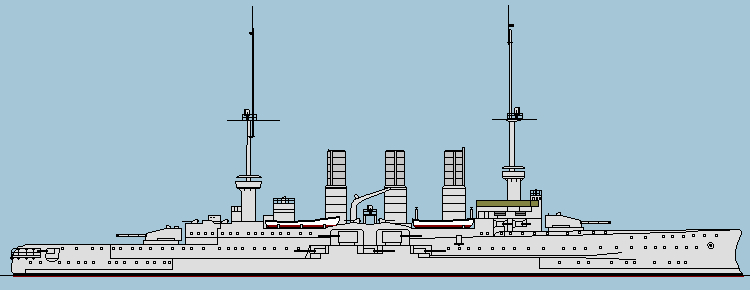
Design and service
Prinz Adalbert combined years of artillery instruction with operational service when the Baltic demanded every available armored vessel.
The full story
After the construction of the armored cruiser Prinz Heinrich, its reduction in armament was heavily criticized. Therefore, the two ships of the following Prinz Adalbert class had the double number of heavy artillery guns, but the size had to reduced to 21 cm again in order not to increase the size of the ship.
Showing the same design principles than the previous classes, those two ships again had an increase in engine power to archive a higher top speed, but like the gun size this was limited by the restriction not to increase the ship size.
They were maneuverable and good seagoing ships, but their outward decks and casemates were flooded even by smaller waves.
Unlike other armored cruisers, both ships were lose early in the war. Prinz Adalbert exploded after a torpedo hit by a British submarine in October 1915, it only served as an artillery training ship before the war.
Operational history
After training and trials the ship is not attached to the fleet, but used as an artillery training ship.
Prinz Adalbert takes part in several autumn fleet maneuvers.
At the outbreak of the war, the armored cruiser is attached to the Baltic fleet and takes part in several operations.
Prinz Adalbert is torpedoed by the British submarine E8 west of Libau. The torpedo hits one of the ammunition stores which explodes. Only three crew members survive.
At a glance
Dimensions, armament, protection and performance.
The archive
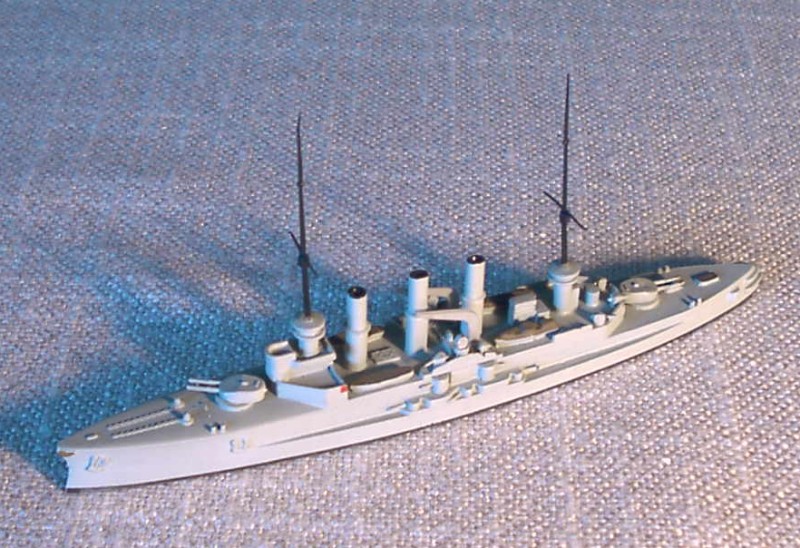
Ship models in 1/1250 scale.
Construction record