Speed as the principal defense
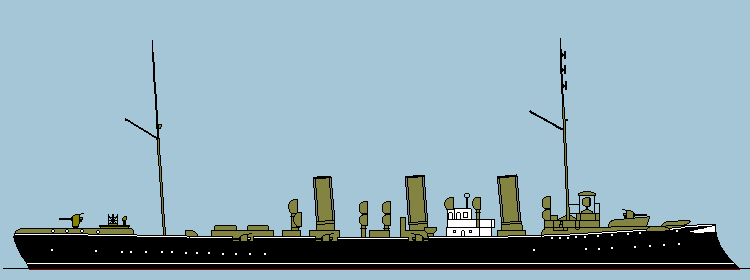
Nineteen knots and numerous light revolver cannon were intended to intercept small attackers before they reached the battle line.
The full story
By the end of the 19th century a new weapon system was seen as an important danger for capital warships - the torpedo boat. With its small size, high speed and deadly weapons they were a very hard target to hit for the gunnery of these days. Therefore, a fast and well armed ship was required which could protect capital warships and defend them against attacking torpedo boats.
The non armored Aviso Greif was built after this requirements. With a speed of 19 knots it was fast enough to intercept torpedo boats, but because of the speed requirements, its main armament was restricted to only two 10,5 cm guns and ten 3,7 cm revolver cannons.
The Greif was only a mediocre seagoing ship as it rolled heavily in higher seas. With the improving speed of newer torpedo boats, the Greif was not able to fulfill its original task, therefore it was later used as a training ship and in the torpedo experimental commando. In addition it served as a reconnaissance vessel for the battle fleet.
Because of its age, it was not reactivated during World War I and scrapped after the war.
Operational history
Greif is commissioned.
Training and trials to the Shetland Islands.
Decommissioned.
Recommissioned, used as fishery protection ship.
Used by Emperor Wilhelm II to welcome various other German warships.
Escort of the Imperial Yacht Hohenzollern in its voyage to scandinavia.
Participation in fleet maneuvers, used as a reconnaissance vessel.
Decommissioned.
After reconstruction, the Greif is recommissioned and attached to the Torpedo-Versuchs-Kommando.
Reconstruction at the Kaiserliche Werft, Kiel, the 10,5 cm guns are replaced with 8,8 cm ones.
Participation in fleet maneuvers.
Repairs and refits.
Decommissioned.
Recommissioned, used as fleet reconnaissance ship.
Used as flagship of the 1st battleship squadron.
Repairs.
Removed from active fleet service, used as an experimental ship for wireless telegraphy and as a training ship.
Decommissioned.
Repairs and refits, new boilers are installed, ship is put into the fleet reserve.
Reclassified as special service ship.
Stricken from fleet list.
Used as mine hulk.
Scrapped in Hamburg.
At a glance
Dimensions, armament, machinery and performance.
Construction record