Protection proven under fire
Strong subdivision and damage control made Seydlitz exceptionally difficult to sink, validating the German emphasis on battlecruiser survivability.
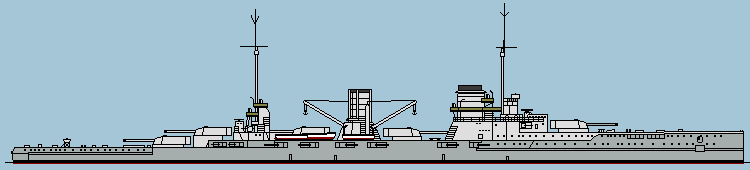
Design and service
The Seydlitz was a slight modified version of the previous Moltke class battlecruisers with several improvements. since the previous battlecruisers had a very low bow height, causing bad seagoing capabilities, this was modified in the Seydlitz design. In addition with a longer hull the increased engine power gave the ship a higher top speed.
The most important improvement was a better armor protection. although armor sizes did not increase very much, the tighter internal subdivision of the ship made it possible that it survived heavy battle damage several times.
The Seydlitz took part in most battlecruiser operations - it lost two turrets during the battle at the Doggerbank and was the most damaged German warship at the battle of Jutland. With over 20 heavy artillery hits, the ship lost two gun turrets again and had a total of about 5400 t water in the ship. Despite this damage, it was still able to return to Germany under its own power - sailing backwards since the bow was only 2,5 meters above the sea level with all the water in the ship.
The final fate of the Seydlitz was the same as of most Imperial Navy ships, it was scuttled at Scapa Flow and broken down between World War I and World War II.
Operational history
Part of the 1st Reconnaissance Group (1. Aufklärungsgeschwader) at the outbreak of the war.
Unsuccessful search for British battlecruisers in the German Beight.
Operation J1: Coastal bombardment of Yarmouth.
Operation J2: Coastal bombardment of Hartlepool.
Battle at the Doggerbank against British battlecruisers. Seydlitz was hit twice, both backward turrets burned out.
During the coastal bombardment of Yarmouth and Lowestoft, the Seydlitz was hit by a mine on the approach and returns to Germany with 1400 t water in the ship.
Battle of Jutland: Seydlitz was the most damaged ship of the German fleet. The battlecruiser sinks the British battlecruiser Queen Mary, but is hit 23 times and by a torpedo of the destroyer Petard. Both backward turrets are burned out again. The ship returns to Germany with over 5300 t water in the ship with its own power, sailing backwards since most damage is in the bow section.
Repairs in Wilhelmshaven.
Unsuccessful raid in the North Sea.
Unsuccessful raid in the Northern North Sea.
Interned at Scapa Flow.
Scuttled by own crew.
Wreck raised.
Broken down at Rosyth.
At a glance
Dimensions, armament, protection and performance.
The archive
Original postcard and photographic material from the private collection.

The archive
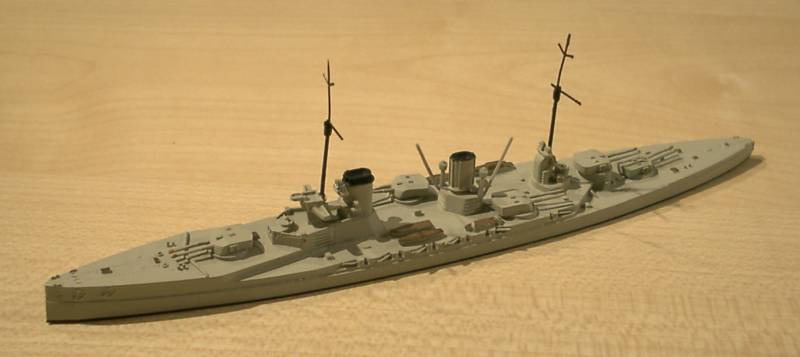
Ship models in 1/1250 scale.
Construction record