A turn-of-the-century battle line
Four 24 cm guns, a heavy secondary battery and improved armor defined the Imperial Navy's next generation of pre-dreadnoughts.
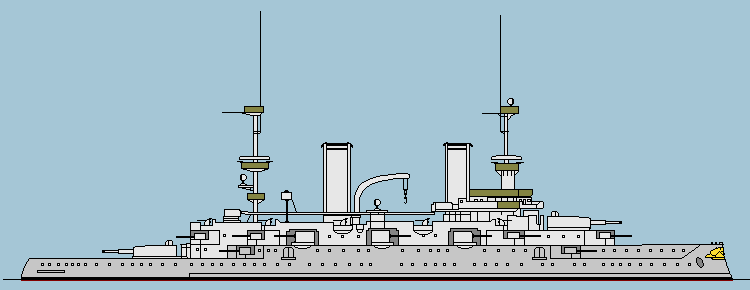
Design and service
The five battleships of the Kaiser Friedrich III class were part of the 1897 naval construction program. With those ships, a new layout for German battleships was introduced which got characterisical for all German battleships.
Unlike their predecessors of the Brandenburg class, the Kaiser Friedrich class was only equipped with 24 cm guns, but the number of secondary guns was more than doubled. They were the first German battleships with three shafts, a characteristic feature that was kept for most German capital ships. In difference to many other German ships, they took not over much water in heavy seas and they were reported to be very good seagoing ships.
All five ships were used for fleet service until 1916, followed by a three year duty as harbor ships before they were decommissioned.
After its fleet service, the Kaiser Karl der Große was used as a prison ship in Wilhelmshaven. In 1920 it were broken down in Rönnebeck.
Operational history
While being transferred from Hamburg to Wilhelmshaven, the non commissioned ship run aground.
Kaiser Karl der Große is commissioned.
Attached to the second squadron.
Voyage around the British Islands.
Participation in the autumn fleet excercises.
Visit to Norway.
Flagship of the 2. Squadron.
Visit to Antwerp to the celebrations of the 75th anniversary of the existance of the Kingdom of Belgium.
Participation in landing operations fleet excercises in the Eckernförde Beight
Decomissioned.
Refits.
Recommissioned after the outbreak of World War I, attached to the V. squadron.
Operations in the eastern Baltic Sea.
Flagship of the 5. Squadron.
Used as a engine training ship in Wilhelmshaven.
Decommissioned.
Disarmed, used as floating barrack for prisoners of war in Wilhelmshaven.
Scrapped in Rönnebeck.
At a glance
Dimensions, armament, protection and performance.
Construction record