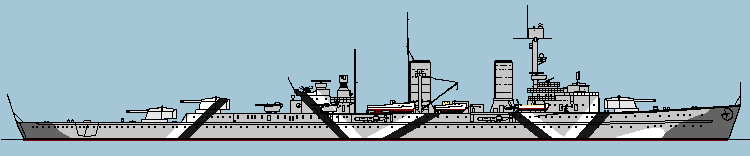
Commissioned.
174,0 mOverall length
7700 tMaximum displacement
32,5 knMaximum speed
514-850Complement
Design and service
The story of Köln
The three K-class light cruisers were the first modern German cruisers completed after World War I. Their 15 cm main guns were mounted in enclosed triple turrets rather than the single mounts used by earlier German light cruisers. The two aft turrets were offset from the centerline to improve their arcs of fire.
Welding was used for about 85 percent of the hull to save weight, but the resulting structure lacked the strength required for prolonged operations in heavy seas. Limited range and structural weakness made the ships unsuitable for their intended commerce-raiding role in the North Atlantic. Königsberg, originally ordered as Kreuzer B, was laid down on 12 April 1926 and completed three years later.
Karlsruhe entered service in November 1929, followed by Köln in January 1930. Before World War II, all three cruisers undertook training cruises and foreign visits. During the war they operated in the North Sea and Baltic Sea.
Königsberg and Karlsruhe were lost during Operation Weserübung, the invasion of Norway, while Köln was sunk near the end of the war.
Köln entered service in January 1930 and combined fleet duties with an extended voyage to Asia, Australia and the Pacific as well as several deployments off Spain. She carried troops to Bergen during Operation Weserübung and later supported operations against the Soviet-held Baltic islands of Dagö and Ösel. In 1941 and 1942 Köln also served as a test platform for the Flettner Fl 282 Kolibri shipborne helicopter. After deployments in Norwegian waters and a period as a training ship, repeated air attacks badly damaged her. Five heavy bombs at Wilhelmshaven sank Köln in shallow water on 31 March 1945, but her main guns remained usable and fired on Allied forces in April.
Operational history
Service timeline
Trials and training in the Baltic and North Sea.
Artillery drills in the North Atlantic, meets Karlsruhe on her first international voyage.
Training and trials in the Baltic Sea.
Voyage to Norway, followed by fleet operations in the North Sea, Jutland and the Baltic Sea.
Training and artillery drills in the Baltic Sea.
Artillery drills in the North Atlantic, followed by training in coastal waters.
First international voyage: Mediterranean, Alexandria, Suez Channel, India, Indonesia, Australia, Pacific, Japan, Tsingtau, China, Indonesia, Ceylon, Suez Channel, Greece, Italy and Spain.
Fleet operations.
Artillery drills together with Panzerschiff Deutschland.
Repairs in Wilhelmshaven.
Fleet operations.
Atlantic operation near Portugal.
Operations at the Spanish coast.
Operations at the Spanish coast.
Several operation at the Spanish coast.
Repairs and refits in Kiel.
Fleet operations.
Repairs and refits in Kiel.
Training in the North Atlantic.
Köln takes part in a North Sea raid together with BC Gneisenau and the destroyers Wilhelm Heidkamp, Friedrich Ihn, Diether von Roeder, Karl Galster, Max Schulz, Paul Jakobi, Bernd von Arnim, Erich Steinbrink and Friedrich Eckoldt with no special events.
Screening a mining mission of five DD with CL Nürnberg and CL Leipzig.
Operation "Weserübung": Part of Squadron 3 (Bergen), returns to Wilhelmshaven on April 11th.
Supports army to take islands Dagö and Ösel, disabling Russian coastal batteries at Cape Ristna.
Tests and trials with ship based helicopter Flettner Fl 282 Kolibri.
Repairs and refits in Wilhelmshaven.
On the way to Norway, the light cruiser Köln, esorted by the destroyer Friedrich Eckold, lays mines near Jutland.
Left Oslo for northern Norway.
Mine laying operation in the North Sea by light cruiser Köln and destroyers Friedrich Ihn, Friedrich Eckoldt and Z24.
Arrived at Narvik, joins Battle Group.
Together with Admiral Scheer and Admiral Hipper, the Köln moves to the Alta Fjord to attack Convoy PQ18. Unsuccessful British submarine attack, the attack on the convoy is stopped.
Admiral Hipper and Köln sail to the Baltic to be withdrawn from service.
Out of service.
The Köln is towed from Kiel to Königsberg.
Recommissioned to train cadet engineers.
Refits.
Battle training.
Mining operations in south Norwegian sea.
Convoy operations between Norway and Denmark.
Heavy damages from bombing attacks: power stations and starboard engine destroyed.
Additional damage cause by repeated bombing attacks.
Sailed to Wilhelmshaven for repairs, damaged by bombs near the island Wangerooge.
Reached Wilhelmshaven.
The CL Köln is sunk after hit by five heavy bombs during the last British night raid on Wilhelmshaven. The ship sinks on its keel, the turrets remain operational even after the ship was taken out of service.
The main artillery is used against troop concentrations near the villages of Neuenburg and Bockhorn for two nights.
At a glance
Technical profile
Dimensions, armament, protection and performance.
Dimensions
- Size (Max)
- 7700 t
- Length (Total)
- 174,0 m
- Length (Waterline)
- 169,0 m
- Beam
- 15,2 m
- Draft
- 6,28 m
- Crew
- 514-850
Armament
- 15 cm C/25 (5,9")
- 9
- 8,8 cm L/45 C/32
- 4 (4 since 1933, 6 since 1936)
- 3,7 cm L/83 C/30
- 8 (since 1934)
- 2 cm MG L/83
- 8 (18 since 1945)
- 53,3 cm Torpedoes
- 12 (50 cm until 1934)
- Mines
- 120
Aircraft
- Heinkel He 60
- 2 (between 1935 and 1935)
- Flettner Fl 265
- 1 (between 1939 and 1940, landing platform on turret B)
Protection
- Deck
- 40 mm
- Belt
- 50-70 mm
- Command Tower
- 100 mm
- Turrets
- 20-20 mm
Machinery
- Shafts
- 3
- Engines
- 4
- Type
- MAN 10-cyl. diesel
- Turbines
- 2
- Type
- Geared turbines
Performance
- Total Performance
- 68485shp
- Speed
- 32,5 kn
- Range
- 7300 miles at 17 kn
The archive
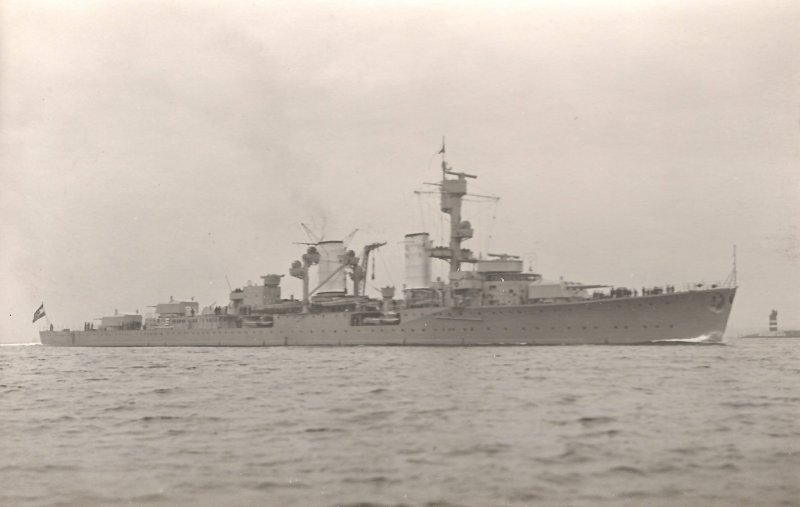
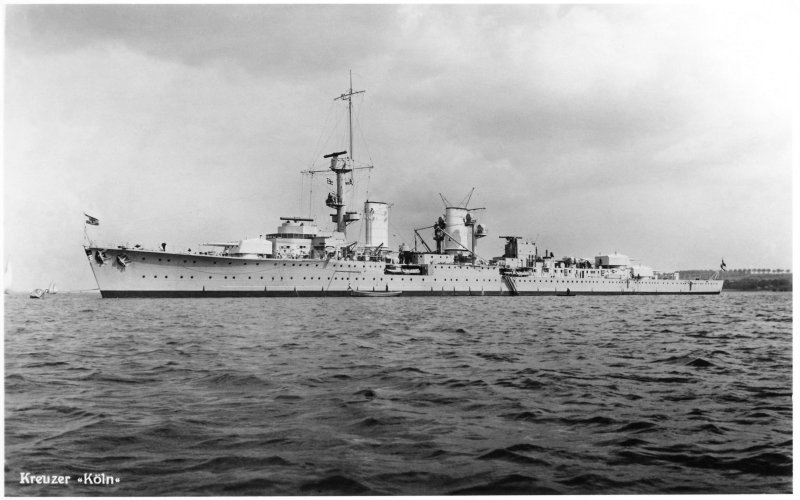
Photographs
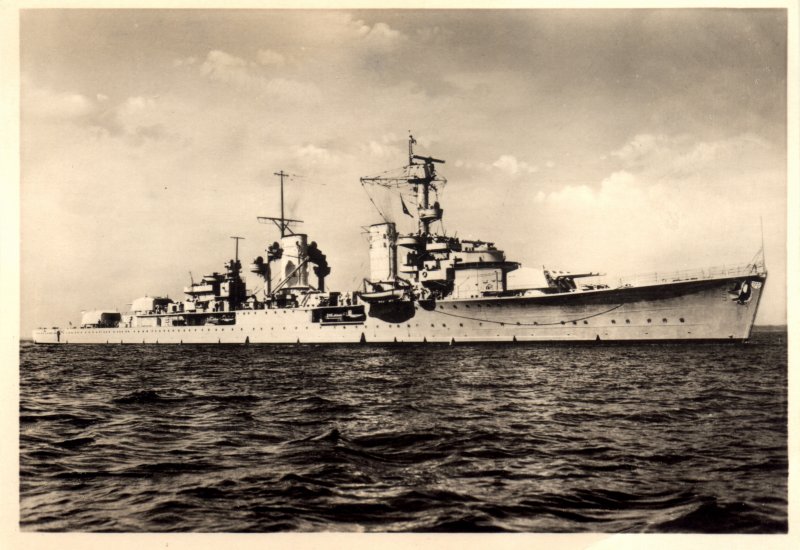
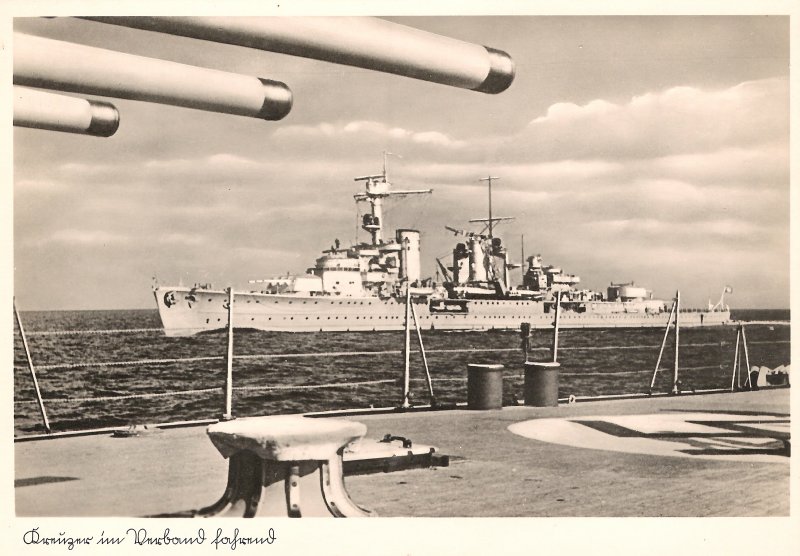
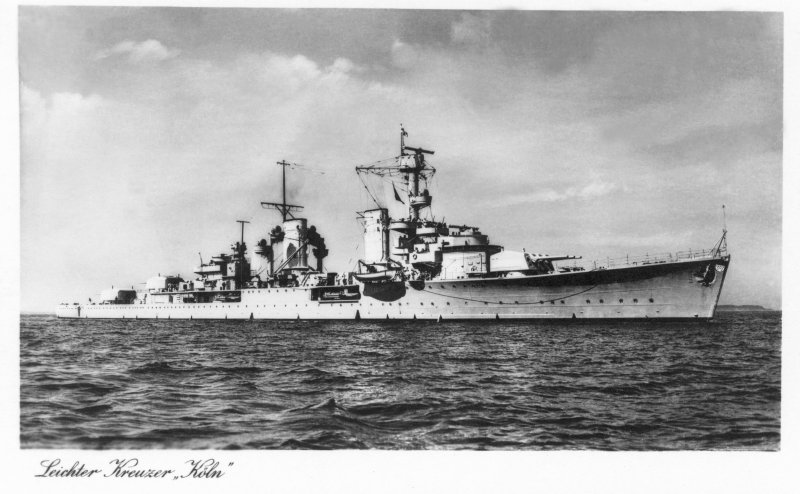
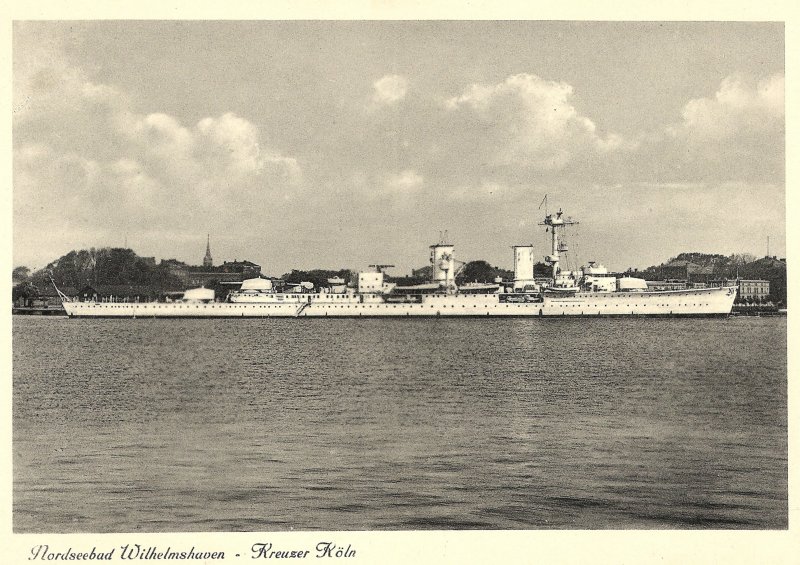
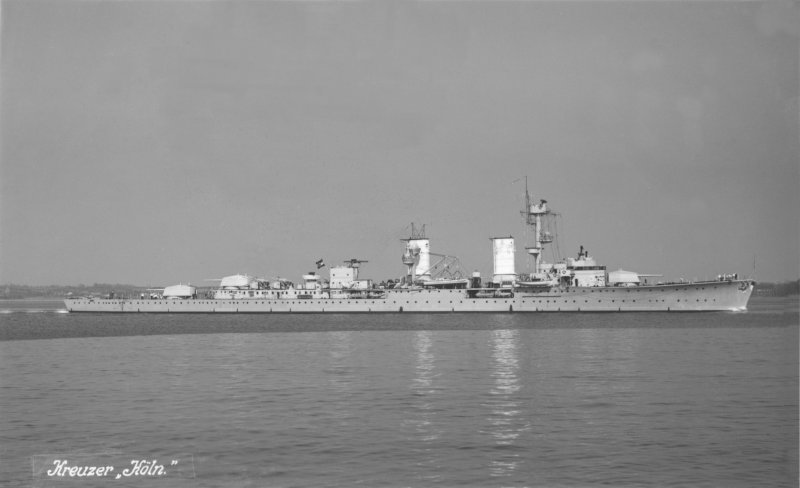
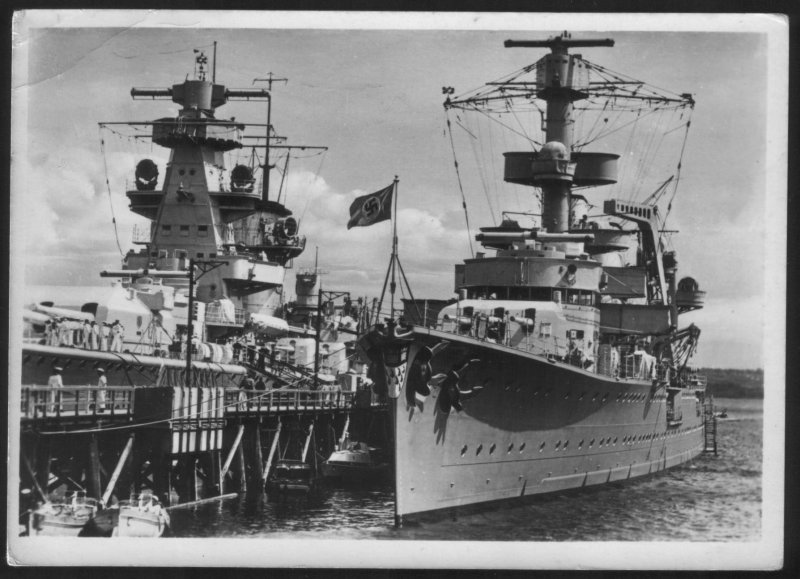
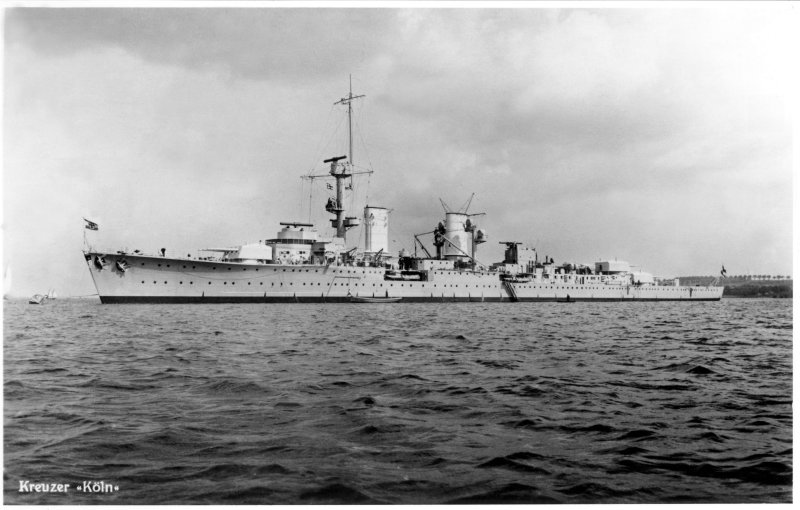
Original postcard and photographic material from the private collection.
The archive
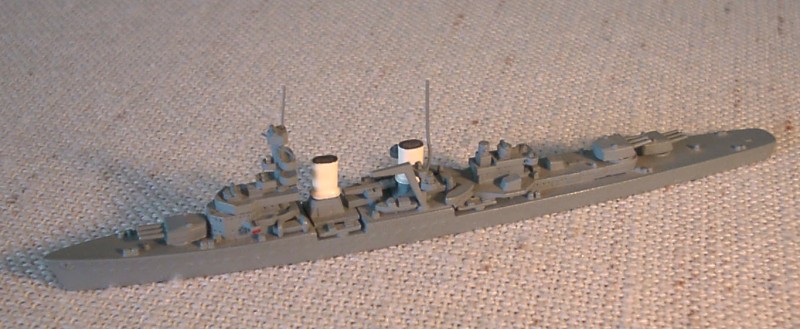
Models
Ship models in 1/1250 scale.
Construction record
Köln
- Laid down
- Reichsmarinewerft Wilhelmshaven, 07.08.1926
- Launched
- 25.05.1928
- Commissioned
- 15.01.1930
- Fate
- sunk by bombs 31.03.1945 (Wilhelmshaven)
- Cost
- 36 Mio Reichsmark