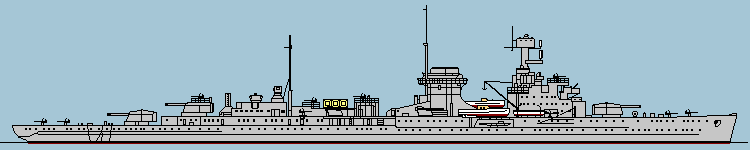
Commissioned, followed by trials until March 1936.
181,3 mOverall length
9040tMaximum displacement
32,0 knMaximum speed
683-896Complement
Design and service
The story of Nürnberg
The design of Kreuzer F (later named Nürnberg) was slightly modified Leipzig, the size grew about 1000 ts and the fuel capacity was dramatically decreased, so the ship had all the flaws of its half sister Leipzig. Built between 1933 and 1935, the Nürnberg was taken over by the Russians after the war and was the last major German ship of World War II when it was decommissioned in 1961.
Operational history
Service timeline
Battle training in the North Atlantic.
Fleet operations in the Baltic Sea.
First Spain operation.
Second Spain operation.
Third Spain operation.
Fourth Spain operation.
Fleet operations.
Visits to Sweden and Norway.
Patrols in the western and middle Baltic Sea.
After the Poland Campaign, the Nürnberg transfers to the North Sea to the B.d.A. Several mine laying operations in the North Sea and along the British coast.
While covering a mine laying operation of five DDs, the British submarine Salmon torpedoes the CLs Nürnberg and Leipzig. Both ships return to Germany.
Repairs in dock.
Joins Scharnhorst, Gneisenau and Admiral Hipper at Drontheim. Scharnhorst and Gneisenau are sent home at July 20th, but the Gneisenau returns after a torpedo hit.
Together with four DDs, the Nürnberg escorts the damaged Gneisenau back to Kiel.
Used in home waters.
Z23, Z25 and Z29 escort the light cruiser Nürnberg on its way to Trondheim.
Joins the battle group consisting of Admiral Hipper, Lützow and Köln in the Altafjord and Tirpitz in Drontheim. The Nürnberg is stationed in Narvik.
After the Admiral Hipper and Köln were sent back to Germany, the Tirpitz, Lützow and Nürnberg are joined by the BC Scharnhorst.
On her voyage back to Germany, the Nürnberg is attacked by two British MTB. Used in the Baltic Sea.
Operations in the Skagerak while laying the "Titus"-minefield.
Stationed in Copenhagen harbor, the Nürnberg defends itself with Flak guns against attacking Danish partisans. The ship surrenders in Copenhagen at the end of the war.
Escorted by the British CA Devonshire and CL Dido, the Prinz Eugen and Nürnberg sail to Wilhelmshaven.
Light cruiser Nürnberg entered on the Soviet navy records and was assigned to the Baltic fleet.
Stationed in in Wilhelmshaven, German crew under command of KzS Helmut Gressler had turned over to the Soviet commission and crew headed by Vice-Admiral Rall
The cruiser, accompanied by other five ex-German ships (namely destroyer Erich Steinbrink, torpedo boats T33 and T107, dispatch vessel Blitz and target ship Hessen) sailed for Libau.
Arrived at Libau. German commander and the remaining German personnel were to be landed there. The ship, according to the memories of the sailors having served aboard her, was remarkable for high quality of construction, quite a good dwelling conditions and, despite some battle damages, was in a good technical conditions. Renamed to Admiral Makarov.
Served as flagship of the 8th (Northern Baltic) fleet (based at Tallinn). The cruiser's entry allowed to replace the only cruiser of the 8th fleet (Kirov), which hit an German magnetic mine on 17.10.1945 and was badly damaged, being put out of action for a long time. During 1949-1950 the ship was partly modernized and repaired in the Kronshtadt by the project of the Central designers' office No.17. During the modernization, the ship war rearmed with Soviet AAguns, including 20 x 3,7 cm guns. At this time, the participated in the shooting the film "Unforgettable nineteenth"
After breakdown of the main boilers, ship was re-classified a training cruiser and employed for the training duties (based at Kronshtadt).
The ship was disarmed and stricken from the Navy records.
The command of the Admiral Makarov was disbanded and ship had been broken up at the Coaling harbor (Leningrad) until February, 1961. By the memories of the old workers from Kronshtadt, which took a part in scrapping the ship, her hull became in amazingly good condition, the "outer wallgang" didn't suffer from the corrosion. After repairs at the shipbuilding facilities in Eastern Germany the cruiser might continue her service for some years more. However, there are two decisive factors that affected on the ship's fate: first, Soviet governments course for "wiping out the cruisers as a class" of the fighting ships which don't conform to the modern conditions of the armed fight; second, categorical requests from Moscow to clear the fleet from the captured ships as not conforming with the existing domestic requests for the constructive vitality (it could be probably explained by the tragedy of the ex-Italian battleship Novorossijsk which sank in Sevastopol in late 1955).
At a glance
Technical profile
Dimensions, armament, protection and performance.
Dimensions
- Size (Max)
- 9040t
- Length (Total)
- 181,3 m
- Length (Waterline)
- 170,0 m
- Beam
- 16,3 m
- Draft
- 5,74 m
- Crew
- 683-896
Armament
- 15 cm C/25 (5.9")
- 9
- 8.8 cm C/32
- 8 (4 since 1945)
- 4 cm
- 2 (since 1945)
- 3,7 cm L/83
- 8 (4 since 1945)
- 2 cm MG L/64
- 4 (29 since 1945)
- 53,3 cm Torpedoes
- 12 (6 since 1941)
- Mines
- 120
Aircraft
- Arado Ar 196
- 2
Protection
- Deck
- 20 mm
- Belt
- 15-50 mm
- Command Tower
- 60 mm
- Turrets
- 20-80 mm
Machinery
- Shafts
- 3
- Engines
- 4
- Type
- MAN 7-cyl. diesel
- Turbines
- 2
- Type
- Deutsche Werke
Performance
- Total Performance
- 78400 shp (12400 shp engines, 66000 shp turbines)
- Speed
- 32,0 kn
- Range
- 2400 miles at 13 kn
The archive
Photographs
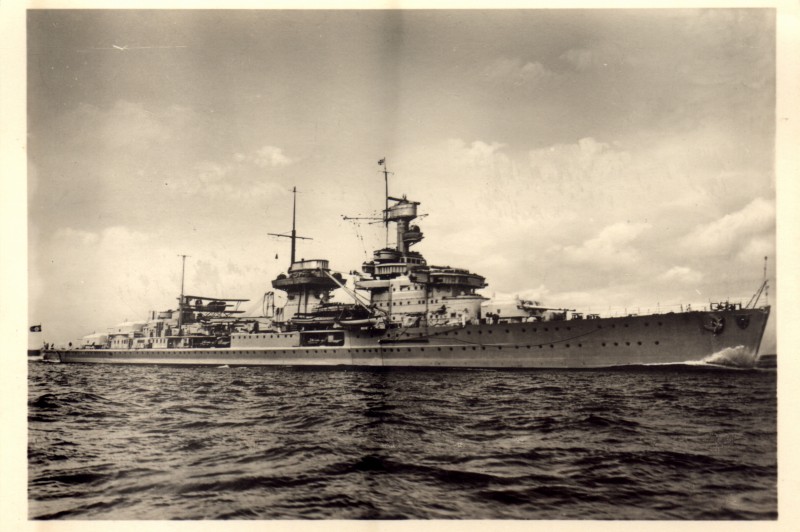
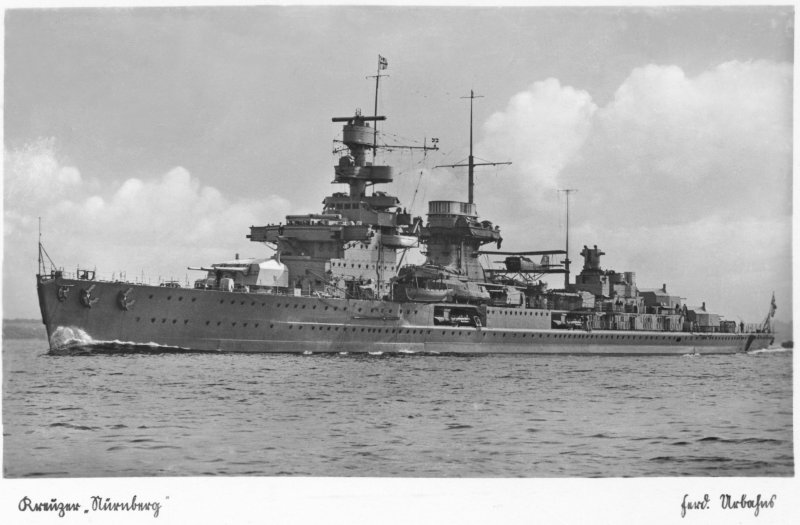
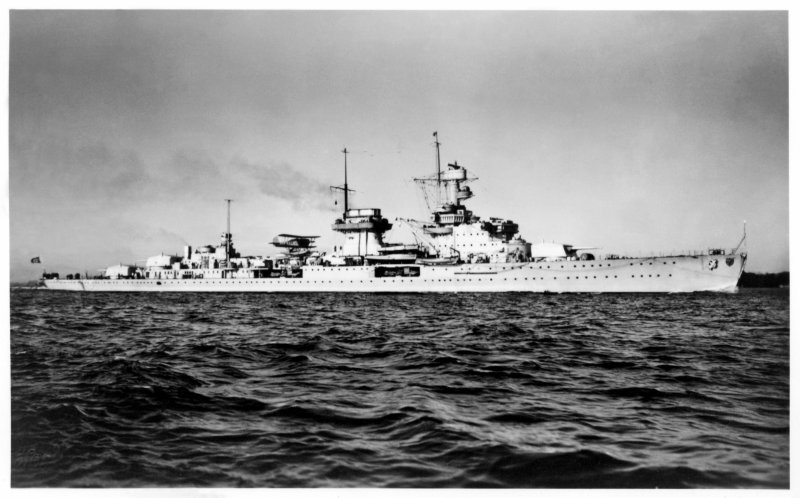
Original postcard and photographic material from the private collection.
The archive
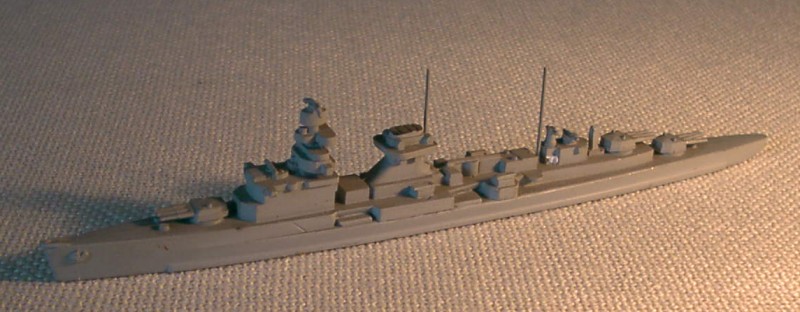
Models
Ship models in 1/1250 scale.
Construction record
Nürnberg
- Laid down
- Deutsche Werke Kiel, 04.11.1933
- Launched
- 08.12.1934
- Commissioned
- 02.11.1935
- Fate
- scrapped 1961
- Cost
- 40 Mio Reichsmark