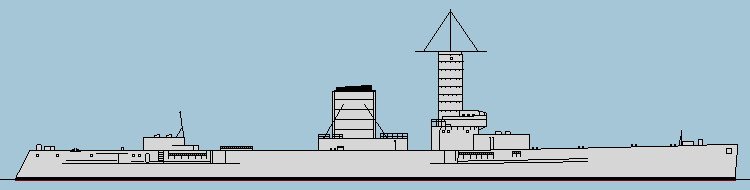
Hessen is commissioned.
Radio-controlled target shipRole
1905–1950Service or project period
Design and service
The story of Hessen
The Hessen was one of the old battleships that Germany was allowed to keep after World War I. After its service as a training ship from 1925 - 1934 the ship was rebuilt as a target ship between 1935 and 01.04.1937. All of its guns and engines were removed and the hull was enlarge with a new bow about 11,70 meters. Its superstructures were cut of, only a funnel and a command tower were left. The engines were replaced with a completely automatic, remote controlled turbine set that allowed the ship to be operated without a crew on board. For longer transfers however, a crew of 80 could stay on board of the ship.
Between 1937 and 1945, the Hessen was used as a target for several major Kriegsmarine warships, and although its superstructure was often damaged in this role, those were only minor and secondary damaged that did not inflict the ships operational status.
The ship survived the war without being damaged by the allies and was taken over by the Soviets. On 02.01.1946 the Hessen left Wilhelmshaven and arrived in Libau six days later. On 03.06.1946 it was renamed to Tsel and served as a target ship in the Baltic fleet until the mid 1950, when it was broken down.
Operational history
Service timeline
Attached to the 2nd Battleship Squadron.
Summer voyage to Norway, landing operation drills at Eckernförde.
Autumn fleet excercises.
Excercises in the North Sea.
Summer voyage to the North and Baltic Sea.
Summer voyage to the Canary Islands.
Summer voyage to El Ferrol.
Summer voyage to Norway.
During the autumn fleet excercises, the Hessen ramms and sink the Danish steamer Askesund.
Ice emergency services in the Baltic Sea,
During the sumer voyage, the Hessen ramms and sinks the torpedo boat G110 in a simulated torpedo attack. Three crew memebers of the torpedo boat are killed.
Summer voyage to Norway.
Summer voyage to Norway.
Hessen runs aground in the Kiel Canal.
Operation in the North Sea.
Repairs in Kiel.
Training excercises in the Baltic Sea.
Operation in the North Sea.
Operation in the North Sea.
Refits in Kiel, additional oil firing is added to boilders.
Operation in the North Sea.
Operation in the North Sea.
Repairs in Wilhelmshaven.
Training excercises in the Baltic Sea.
Repairs in Hamburg.
Costal defence duty.
Operation in the North Sea.
Refiets, additional anti-ballon guns are installed.
Battle of Jutland: Hessen returns undamaged.
Hessen assists the König Albert which has run aground near Krautsand.
Used as target ship in the Baltic Sea.
Decommissioned.
Recommissioned.
Voyage to Norway.
Autumn fleet excercises.
Ice emergency services in the eastern Baltic Sea, voyage to Libau and Riga.
Voyage to Spain.
Atlantic voyage to the Carary Islands and Portugal.
First visit to Danzig after WW1.
Visit to Norway.
Voyage to Spain.
Visit to Stockholm.
Participation in fleet voyate to the Mediterranean.
Fleet day in Swinemünde.
Visit to Norway.
Visits to Visby, Oslo and Danzig.
Visit to Reval.
Visit to Bergen and Sognefjord.
Decommissioned in Wilhelmshaven.
Reconstruction as radio controlled target ship: Two funnels, masts and guns are removed.
Used as target ship.
First operational use as target ship for the light cruiser Leipzig.
After World War II, the Hessen is taken over by the Soviet Union. The ship and its control boat Blitz are renamed to Tsel and Wystrel.
At a glance
Technical profile
Dimensions, armament, machinery and performance.
Dimensions
- Size (Max)
- 13257 t
- Length (Total)
- 137,7 m
- Beam
- 21,5 m
- Draft
- 7,65 m
- Crew
- 80 (only when not used as a target)
Armor
- Deck
- 140-170 mm
- Belt
- 225 mm (max)
- Command tower
- 300 mm
Machinery
- Shafts
- 2
- Turbines
- 2
- Type
- Geared Turbines
Performance
- Total Performance
- 25000 shp
- Speed
- 20,3 kn
The archive
Photographs
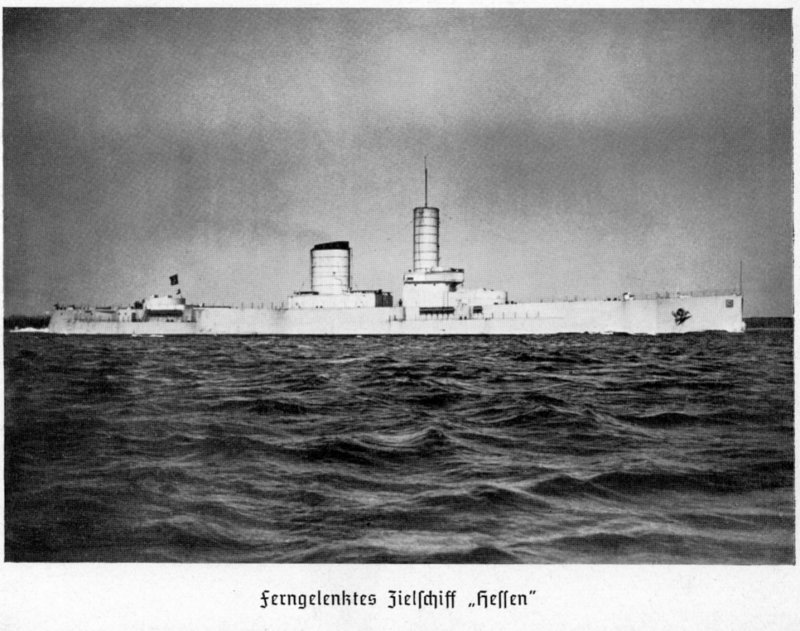
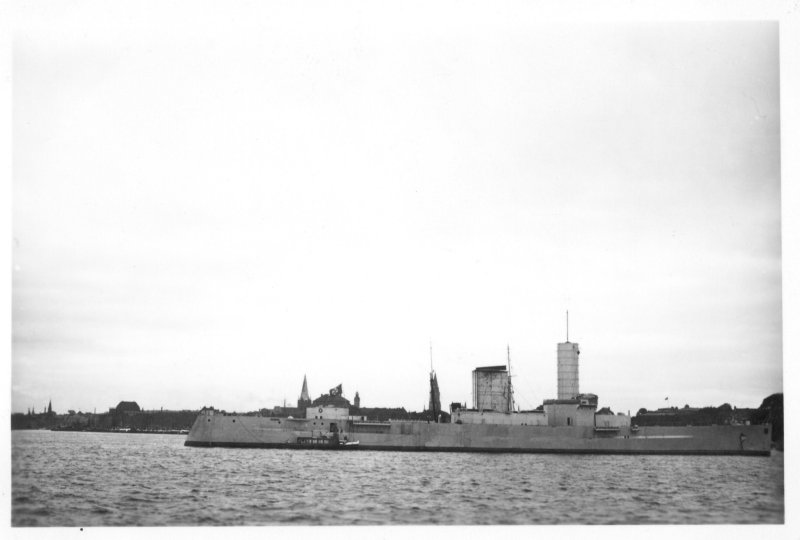
The archive
Models
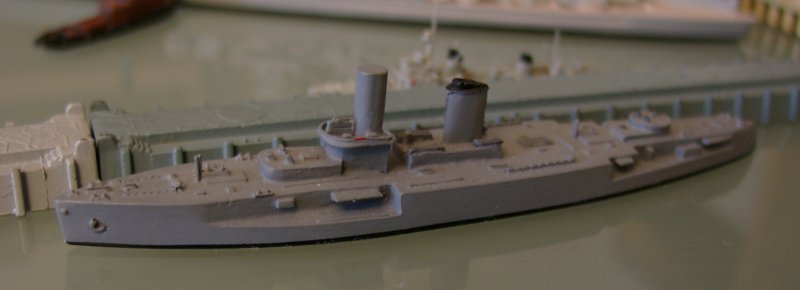
Ship models in 1/1250 scale.
Construction record
Hessen
- Laid down
- Germaniawerft Kiel, 15.04.1902
- Launched
- 18.09.1903
- Commissioned
- 19.05.1905
- Fate
- scrapped in the 1950s in Russia