A new kind of German capital ship
Turbine propulsion, high speed and eight 28 cm guns created a fast capital ship designed to scout with the fleet and fight enemy cruisers.
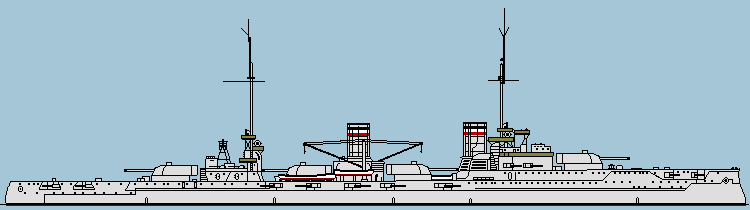
Design and service
With the construction of the first British battlecruisers of the Invincible class, it became clear that those ships would easily outperform the German Panzerkreuzer (or Große Kreuzer as they were officially called). With their main task being the center of the reconnaissance force, the Panzerkreuzer would have been without chance against British reconnaissance forces consisting of battlecruisers (as it was shown in the Battle of the Falklands).
As a reaction to the Invincible, Germany built its first battlecruiser, the Von der Tann. Being the first major warship with turbine engines, it was a major advance from the last Panzerkreuzer built, the Blücher, during trials, the turbines were able to produce almost twice as much power as they were originally designed for.
Although having smaller guns than the British ship (28 cm compared to 30,5 cm) the Von der Tann was much better protected than they, a design philosophy - smaller guns in favor of better protection - which was used in almost all ships built in this time and proved to be essential during the battle of Jutland
Von der Tann and its successors looked all quite identical and all shared the same problem, caused by the low bow height, they took over much water at high speed or bad weather condition.
The ship was part of the 1st Reconnaissance group (1. Aufklärungsgruppe) and took part in most major operations.
Operational history
Training and trials with shipyard crew.
Von der Tann is commissioned.
Voyage to South America, including a visit to Rio de Janeiro and Buenos Aires.
Attached to the 1st Reconnaissance Group.
Participation at the fleet parade in Spithead.
Von der Tann is assigned as flagship of the reconnaissance forces.
Repairs in Wilhelmshaven.
Part of the 1st Reconnaissance Group (1. Aufklärungsgeschwader) at the outbreak of the war.
Raid into the North Sea.
Unsuccessful search for British battlecruisers in the German Beight after the Battle at Helgoland.
Operation J1: Coastal bombardment of Yarmouth.
Operation J2: Coastal bombardment of Scarborough.
Operations in the Baltic Sea.
Operations in the North Sea.
Operations in the North Sea.
Operations at the Hoofoten.
Coastal bombardment of Yarmouth and Lowestoft.
Battle of Jutland: Von der Tann was hit four times but sinks the British BC Indefatigable. The ship had 35 wounded and 11 crew members were killed.
Repairs in Wilhelmshaven.
Unsuccessful raid in the North Sea.
Unsuccessful raid in the North Sea.
Unsuccessful raid in the North Sea.
Repairs after turbine damages.
Unsuccessful raid in the North Sea.
Repairs after turbine damages.
Unsuccessful raid in the North Sea.
Interned at Scapa Flow.
Scuttled by own crew.
Wreck raised.
Broken down at Rosyth.
At a glance
Dimensions, armament, protection and performance.
The archive
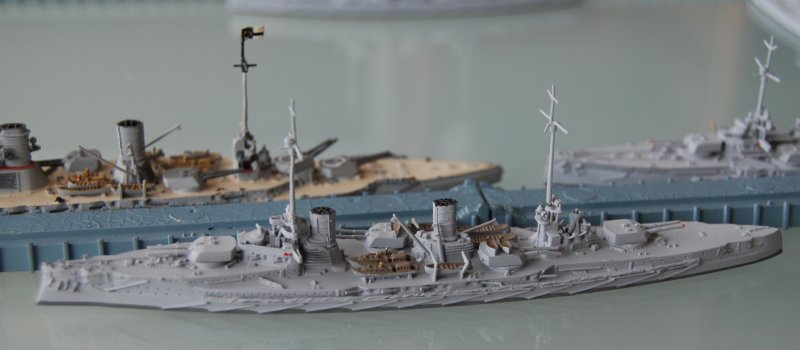
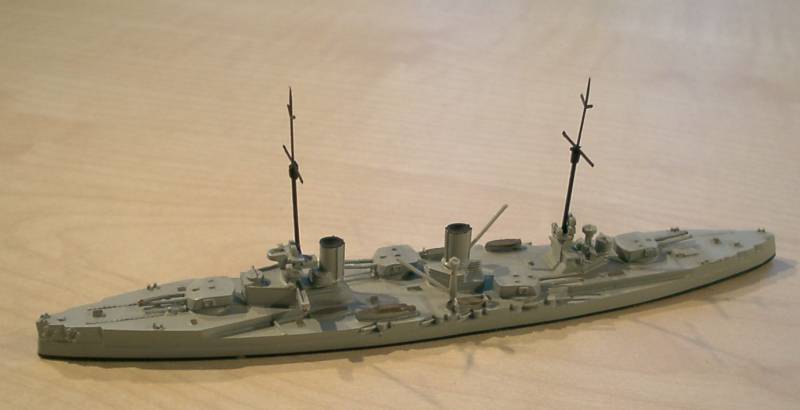
Ship models in 1/1250 scale.
Construction record