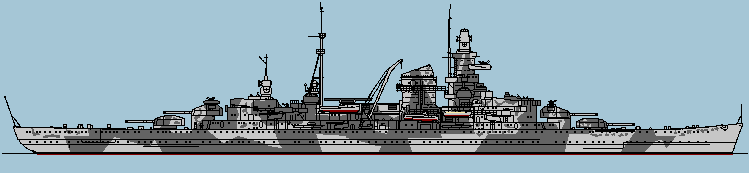
Final Trials.
205,9 mOverall length
18200 tMaximum displacement
32,5 knMaximum speed
~1600Complement
Design and service
The story of Admiral Hipper
The Admiral Hipper class emerged from Germany's return to heavy-cruiser construction in the 1930s. Although conceived within the 10,000-ton, 20.3 cm-gun limits associated with the Washington treaty system, the completed ships were substantially larger than the nominal limit.
Five ships were laid down between 1935 and 1937. Admiral Hipper and Blücher formed the first group, while Prinz Eugen, Seydlitz and Lützow incorporated an improved design. Seydlitz and Lützow were initially considered as 15 cm-gun light cruisers, but both were reordered with 20.3 cm guns. The class was intended for commerce warfare, combining heavy armament with sufficient speed to avoid stronger opponents.
In practice, the ships' high-pressure steam machinery consumed too much fuel for sustained Atlantic operations and proved difficult to maintain. Only Admiral Hipper, Blücher and Prinz Eugen were completed as heavy cruisers; construction of Seydlitz and Lützow remained unfinished.
Admiral Hipper entered active service in early 1940 and saw her first major action during Operation Weserübung, when she sank the British destroyer Glowworm while carrying troops to Trondheim. She later raided Atlantic shipping, attacking convoys WS 5A and SLS 64, before moving to Norway for operations against Arctic convoys. During the Battle of the Barents Sea in December 1942 she damaged two British escorts but was herself hit, and the failure of the operation ended her active front-line career. Recommissioned as a training ship in 1944, Admiral Hipper evacuated 1,529 refugees from Gotenhafen in January 1945. British bombs badly damaged her at Kiel, where her crew scuttled the ship on 3 May 1945.
Operational history
Service timeline
Commissioned.
Training and trials.
Training voyage to Sweden and Estland.
Patrols in the Baltic Sea.
Final construction in Hamburg: New bow and funnel cap added.
Trials and training in the Baltic Sea.
Admiral Hipper is put into active fleet service.
Together with BCs Scharnhorst, Gneisenau and several destroyers, the Admiral Hipper operated between Britain and Scandinavia to attack allied convoys. No enemy ships were found during this operation.
Operation "Weserübung": Heading to Drontheim, Admiral Hipper and the destroyers Bernd von Arnim and Hans Lüdemann engaged the British destroyer Glowworm. The Glowworm was sunk, but Admiral Hipper collided with the wreck.
After landing troops in Drontheim, Admiral Hipper joins BCs Scharnhorst, Gneisenau on their way back to Germany. Although the British Home fleet is also operating in the same area, both sides do not meet.
Repairs in Wilhelmshaven.
Operation "Juno" Along with BCs Scharnhorst, Gneisenau and the destroyers Karl Galster, Hans Lody, Erich Steinbrinck and Hermann Schoemann, Admiral Hipper raids the area of Hastad, Norway and sink the troop transport Orama, the tanker Oil Pioneer and the submarine hunter Juniper.
Admiral Hipper and BC Gneisenau start an operation against the British northern Patrol, but the operation is canceled after Gneisenau is hit by an torpedo the next day.
Operation against allied merchant shipping in the Arctic sea, only neutral ships are detected.
Repairs in Wilhelmshaven.
Admiral Hipper is planned to be used for support operation for "Operation Seelöwe".
Repairs in Hamburg after engine failure.
Operation "Nordseetour": First Atlantic mission: Attacks convoy WS5A about 700 miles west of Cape Finestre and engages British CA Berwick and DDs. Berwick and one merchant were severely damaged, another merchant sunk. Admiral Hipper returns to Brest, France.
Second Atlantic Mission: On Feb. 11, Admiral Hipper attacks the unprotected convoy SLS64 at 37°12'N, 21°20'W, sinking 7 of the 19 merchants and damaging several others. Due to fuel shortage, Admiral Hipper has to return to Brest, France.
Returns to Kiel via the Denmark Strait.
Escorted by the destroyers Z24, Z26, Z30 and the torpedo boats T15, T16 and T17, Admiral Hipper is sent to Drontheim, Norway.
Operation "Rösselsprung": Together with BB Tirpitz, CA Admiral Scheer, escorted by the destroyers Karl Galster, Theodor Riedel, Friedrich Ihn, Hans Lody, Z24, Z27, Z28, Z29, Z30 and the torpedo boats T15 and T7, the Admiral Hipper searches for the convoy PQ17 in the arctic sea. Although no contact was made, two third of the convoy is destroyed by U-boats and aircraft.
Admiral Hipper, Admiral Scheer, the CL Köln and several destroyers relocate to the Altafjord.
Along with the destroyers Z23, Z28, Z29 and Z30, Admiral Hipper is doing the offensive mine operation "Zarin" off the north west coast of Novaja Semlija.
The heavy cruiser Admiral Hipper is escorded by Z23, Z28, T9 and T12 on its way from the Altafjord to the Bogenbucht.
Richard Beitzen and Friedrich Eckoldt escort the heavy cruiser Admiral Hipper to the Alta-Fjord.
The 5th destroyer flotilla, consisting of Richard Beitzen, Friedrich Eckoldt, Z27 and Z30, escort the heavy cruiser Admiral Hipper during an operation into the Barents Sea to attack allied shipping.
Battle in the Barents Sea: Admiral Hipper, CA Lützow and the six destroyers Richard Beitzen, Theodor Riedel, Friedrich Eckoldt, Z24, Z30 and Z31, attacks convoy JW51B at 73°N, 29°E. Hipper sinks mine seeker Bramble and damages DD Achates (which is later sunk) but the attack is aborted after the British CL Sheffield and Jamaica archive one hit on the Admiral Hipper. During the battle, in which only one merchant is damaged, DD Friedrich Eckoldt is sunk.
After provisorical repairs, the Admiral Hipper is sent back to Germany via Drontheim.
Arrived in Kiel.
Transferred to Wilhelmshaven and put out of service.
Because of the increasing air threats, Admiral Hipper is town to Pillau.
Admiral Hipper recommissioned.
Used as a training ship.
Repairs in Gotenhafen (Gdynia).
Admiral Hipper leaves Gotenhafen (Gdynia) with 1529 refugees on board following the passenger ship Wilhelm Gustloff to Kiel. The Wilhelm Gustloff was torpedoed by a Russian submarine, but Admiral Hipper arrived at Kiel unharmed on 02.02. 1945.
Admiral Hipper is hit by bombs during a British air attack. The ship is heavily damaged.
Again hit during an air attack, superstructures heavily damaged.
Blown up in the dock of Deutsche Werke, Kiel.
Moved to Heikendorf Bight and scrapped by the British.
At a glance
Technical profile
Dimensions, armament, protection and performance.
Dimensions
- Size (Max)
- 18200 t
- Length (Total)
- 205,9 m
- Beam
- 21,3 m
- Draft
- 7,7 m
- Crew
- ~1600
Armament
- 20,3cm SK (8")
- 8
- 10,5 cm L/65 C/33
- 12
- 4 cm Flak
- 6
- 3,7 cm L/83
- 8
- 2 cm MG L/64
- 32
- 53,3 cm Torpedoes
- 12
Aircraft
- Arado Ar 196
- 3
Protection
- Deck
- 12-50 mm
- Belt
- 70-80 mm
- Command Tower
- 50 - 150 mm
- Turrets
- 70 - 105 mm
Machinery
- Shafts
- 3
- Turbines
- 3
- Type
- Blohm & Voß
Performance
- Total Performance
- 132000 shp
- Speed
- 32,5 kn
- Range
- 8000 miles at 20 kn
The archive
Photographs
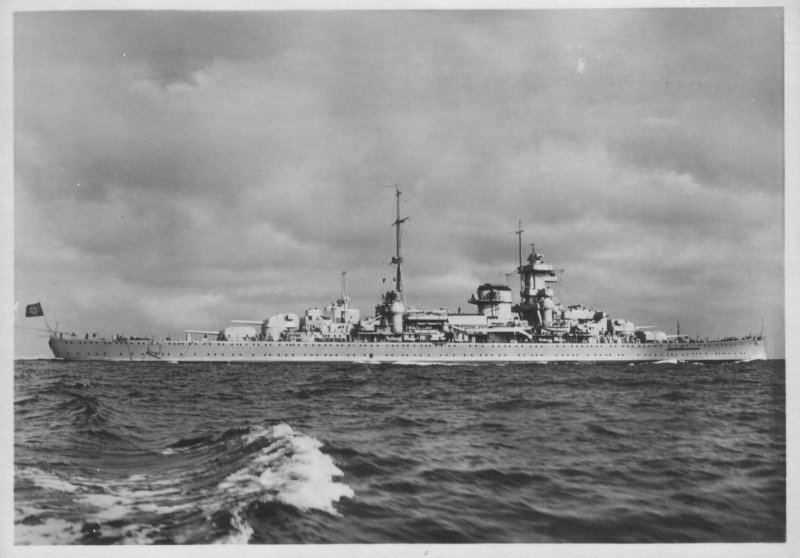
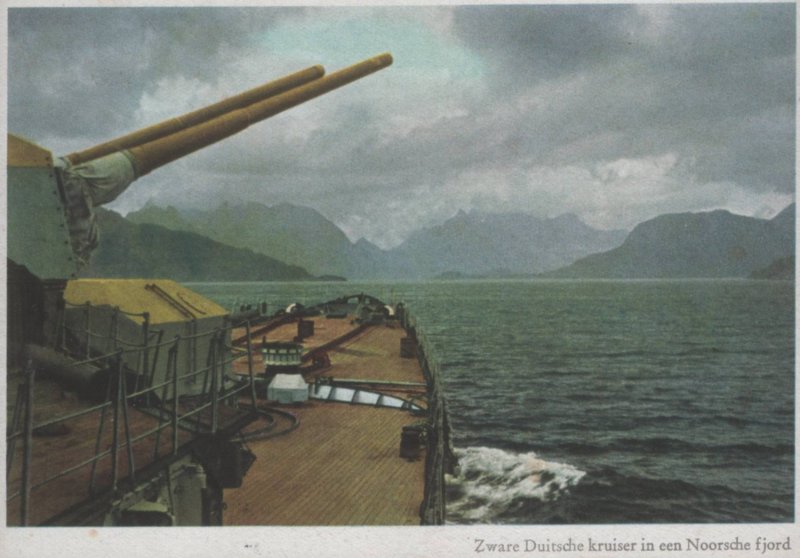
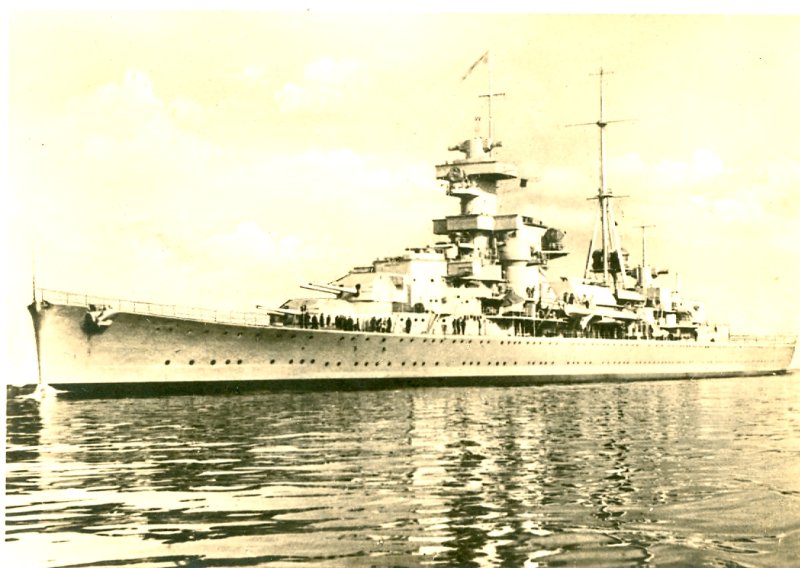
Original postcard and photographic material from the private collection.
Construction record
Admiral Hipper
- Laid down
- Blohm & Voß Hamburg, 06.07.1935 (Slipway 2)
- Launched
- 06.02.1937
- Commissioned
- 29.04.1939
- Fate
- blown up 03.05.1945 (Kiel Shipyard)
- Cost
- 85,8 Mio Reichsmark