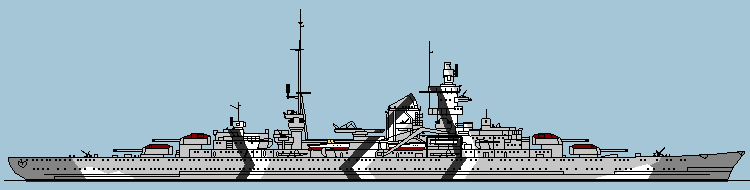
Before commissioned, the Prinz Eugen was twice hit by British bombs in the Germaniawerft, Kiel
212,5 mOverall length
18400 tMaximum displacement
33,5 knMaximum speed
~1600Complement
Design and service
The story of Prinz Eugen
The Admiral Hipper class emerged from Germany's return to heavy-cruiser construction in the 1930s. Although conceived within the 10,000-ton, 20.3 cm-gun limits associated with the Washington treaty system, the completed ships were substantially larger than the nominal limit.
Five ships were laid down between 1935 and 1937. Admiral Hipper and Blücher formed the first group, while Prinz Eugen, Seydlitz and Lützow incorporated an improved design. Seydlitz and Lützow were initially considered as 15 cm-gun light cruisers, but both were reordered with 20.3 cm guns. The class was intended for commerce warfare, combining heavy armament with sufficient speed to avoid stronger opponents.
In practice, the ships' high-pressure steam machinery consumed too much fuel for sustained Atlantic operations and proved difficult to maintain. Only Admiral Hipper, Blücher and Prinz Eugen were completed as heavy cruisers; construction of Seydlitz and Lützow remained unfinished.
Prinz Eugen entered service in August 1940 and accompanied Bismarck during Operation Rheinübung, taking part in the Battle of the Denmark Strait before reaching Brest independently. She returned to Germany through the English Channel during Operation Cerberus in February 1942, then lost her stern to a torpedo from the British submarine Trident. From 1944 she supported German forces retreating along the Baltic coast with naval gunfire. The cruiser surrendered at Copenhagen in May 1945 and was transferred to the United States. After surviving both atomic tests at Bikini Atoll, she developed an uncontrollable list and capsized at Kwajalein on 22 December 1946.
Several artifacts from Prinz Eugen survive today. One of her Arado Ar 196 aircraft is preserved by the Smithsonian Institution, while the ship's bell is held by the National Museum of the United States Navy in Washington, D.C. Guns removed from turret Anton before the Bikini tests remain at the naval test facility in Dahlgren, Virginia, and one of the ship's propellers is displayed at the Naval Memorial in Laboe, Germany.
Operational history
Service timeline
Commissioned
Final construction work in Kiel.
Training in the Baltic Sea.
Operation "Rheinübung": Leaves Gotenhafen (Gdynia) together with battleship Bismarck.
Anchoring in the Kors Fjord, Prinz Eugen and Bismarck are spotted by British air reconnaissance.
Battle with British battlecruiser Hood and battleship Prince of Wales. Prinz Eugen scores the first hit on the Hood which later explodes in the battle. After the Battle, in which the Prince of Wales is damaged too, the Prinz Eugen is sent off in the North Atlantic while the Bismarck tried to escape to France.
Returns to Brest because of engine problems.
Hit by a bomb in dock in Brest.
Operation "Cerberus": Returns to Germany via the British Channel together with battlecruisers Scharnhorst and Gneisenau, escorted by 6 destroyers (Paul Jakobi, Richard Beitzen, Friedrich Ihn, Hermann Schoemann, Z25, Z29) and 14 torpedo boats (e.g. Kondor, Jaguar, T12, T13)
Lost stern after a torpedo hit from the British submarine Trident outside the Drontheim Fjord while on transfer to Norway.
Repairs in Kiel.
Battle training in Baltic Sea together with Panzerschiff Lützow.
Two unsuccessful transfer attempts to Norway.
Used as a training ship.
Stationed at the Finnish coast.
Shore bombardment at the Kurland front line.
Supported retiring German Army at Memel.
Collides with light cruiser Leipzig north of Hela, only light damage at the Prinz Eugen.
Continued support of the German Army.
Prinz Eugen sails to Copenhagen.
Placed under British command.
Handed over to the U.S., renamed as USS IX 300.
Sails to the United States.
Transferred to Honolulu.
Used in atomic bomb test "Able", only light damage.
Used in atomic bomb test "Baker", ship took some damage below the waterline. After the tests, the Prinz Eugen is towed to the Kwajalein Atoll.
After six days of increased list, the Prinz Eugen capsized and sinks.
At a glance
Technical profile
Dimensions, armament, protection and performance.
Dimensions
- Size (Max)
- 18400 t
- Length (Total)
- 212,5 m
- Beam
- 21,8 m
- Draft
- 7,2 m
- Crew
- ~1600
Armament
- 20,3cm SK (8")
- 8
- 10,5 cm L/65 C/33
- 12
- 4 cm Flak
- 17
- 2 cm MG L/64
- 28
- 53,3 cm Torpedoes
- 12
Aircraft
- Arado Ar 196
- 3
Protection
- Deck
- 12-50 mm
- Belt
- 70-80 mm
- Command Tower
- 50 - 150 mm
- Turrets
- 70 - 105 mm
Machinery
- Shafts
- 3
- Turbines
- 3
- Type
- Germania
Performance
- Total Performance
- 136000 shp
- Speed
- 33,5 kn
- Range
- 7200 miles at 20 kn
The archive
Photographs
Original postcard and photographic material from the private collection.
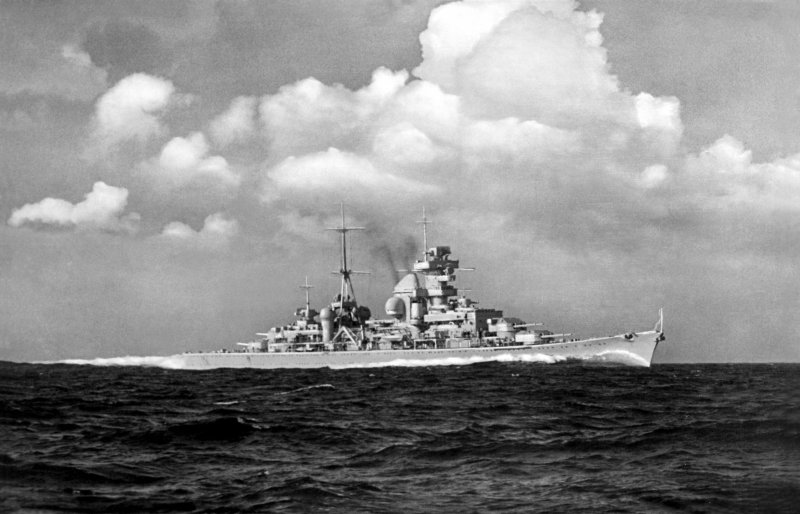
The archive
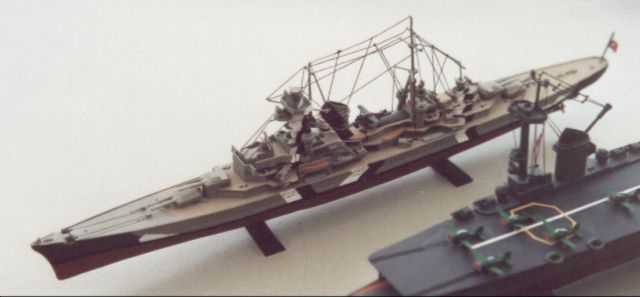
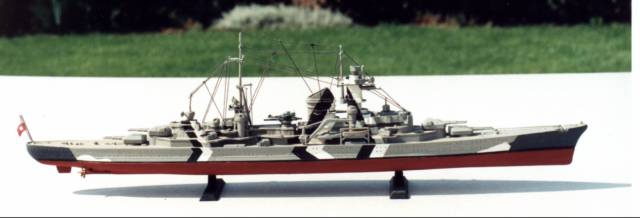
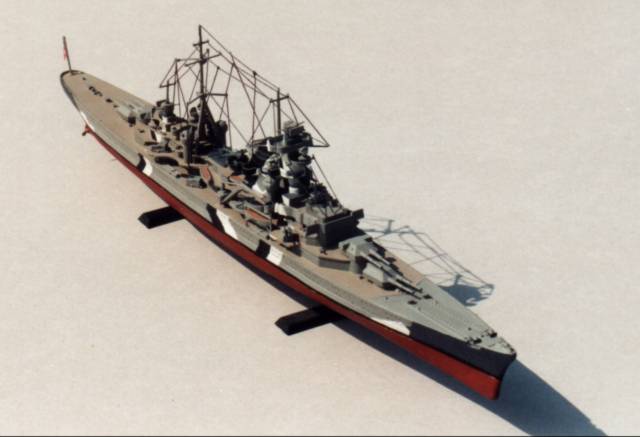
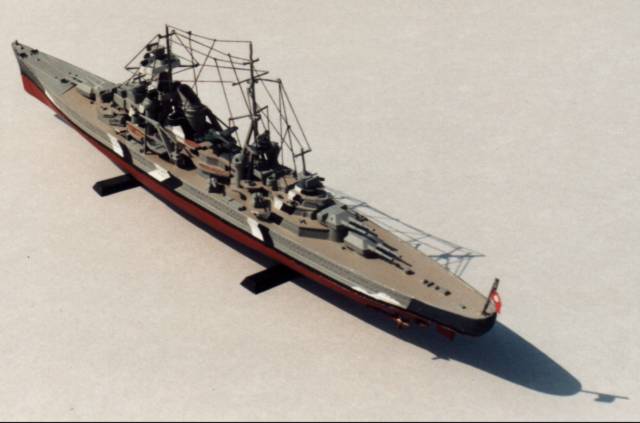
Models
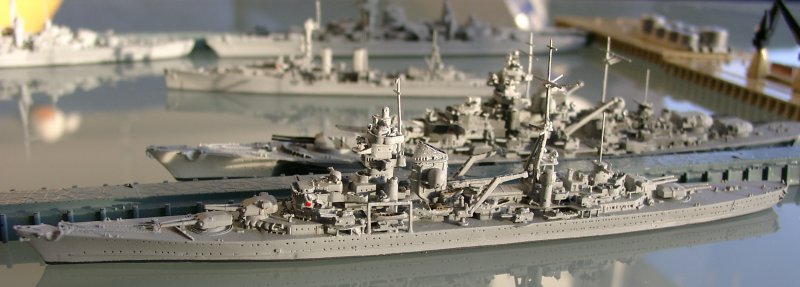
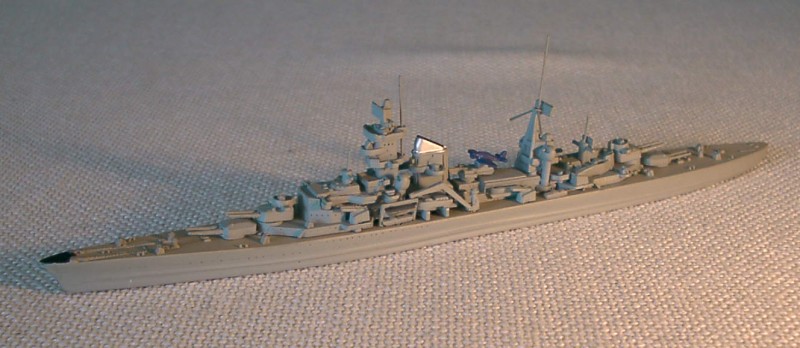
Ship models in 1/1250 scale.
Construction record
Prinz Eugen
- Laid down
- Germaniawerft Kiel, 23.04.1936 (Slipway 2)
- Launched
- 22.08.1938
- Commissioned
- 01.08.1940
- Fate
- sunk summer 1946 (Kwajalein-Atoll)
- Cost
- 104,5 Mio Reichsmark