A powerful design overtaken by events
Built in response to misunderstood British plans, Blücher carried twelve 21 cm guns but lacked the speed and firepower of the battlecruisers she ultimately faced.
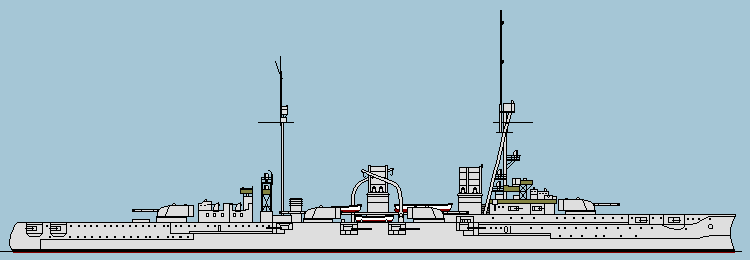
Design and service
Blücher maximized the traditional armored-cruiser formula just as HMS Invincible made that entire type strategically obsolete.
The full story
With the armored cruiser Blücher, a huge step from the outdated armored cruiser design to the modern battlecruiser was made, besides its smaller main artillery the ship showed many elements that were typical for the later battlecruisers. Because of all innovations like the all-turret main artillery, more powerful steam engine, the installation of a torpedo protection bulkhead and more modern general layout, the size grew about 25% compared to its predecessors of the Scharnhorst class.
One special design detail later proved to be fatal for this armored cruisers. Because of the huge size of its engine system, there was no room to add own ammunition stored under the forward side turrets. Instead those turrets were connected to the forward turret and afterward side turrets via ammunition transport tunnels below the armor deck.
Although the Blücher was much improved compared to its predecessors, it got obsolete with the introduction of the British Invincible class battlecruisers, and despite this knowledge, the Blücher operated together with other battlecruisers in the fleet to increase the number of ships available for the reconnaissance forces. This usage finally led to its fatal end.
Operational history
Commissioned, followed by intensive tests and trials.
Blücher is flagship of the Reconnaissance Forces when it enters the Hochseeflotte
Secondary assignment as artillery test ship.
Long-range artillery training at the Faroe Islands.
Fleet maneuvers.
Fleet maneuvers.
Artillery training in the North Sea.
Blücher run aground near the Island of Romsoe. The ships had to be towed to Kiel for repairs.
Repairs in Kiel. The forward mast is replaced with a tripod mast - the first mast of this kind on a German warship.
After the outbreak of the war, the Blücher is attached to the 1st Reconnaissance Squadron due to the low number of available battlecruisers.
Together with several older battleships and cruisers, the Blücher operated in the Baltic Sea in the area of Gotland to attack Russian ships. Although the German ships get in contact wit the Russians, the Blücher was not involved in this battle.
Operation J1: Coastal bombardment of Yarmouth.
Operation J2: Coastal bombardment of Hartlepool, the Blücher is hit four times by coastal batteries (15,2 cm).
Battle at the Doggerbank against British battlecruisers: German reconnaissance forces, consisting of the battlecruisers Seydlitz, Moltke, Derfflinger and the Blücher, four Cls and 18 torpedoboats are engaged by British battlecruisers Lion, Tiger, Princess Royal, New Zealand and Indomitable, seven CLs and 33 destroyers. The German ships try to evade to the southeast, with this maneuver, the Blücher is the last ship of the formation. On 09:52, the faster British ships opened fire on the Blücher. In the following battle, several ships were damaged, Blücher alone was hit 70-100 times, including one lethal hit in the ammunition transport tunnel to the forward side turrets. To save the remaining ships, the Germans leave the Blücher in the battlefield, the armored cruiser sinks on 13:13 causing 792 casualties in its crew.
At a glance
Dimensions, armament, protection and performance.
The archive
Original postcard and photographic material from the private collection.
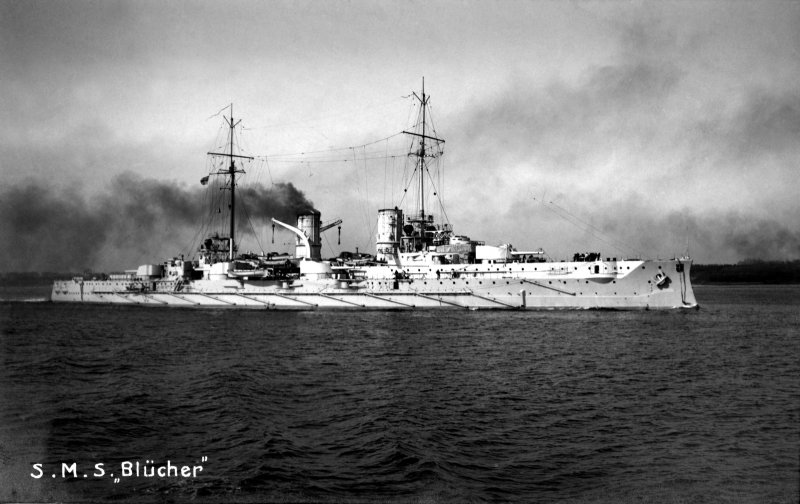
The archive
Ship models in 1/1250 scale.
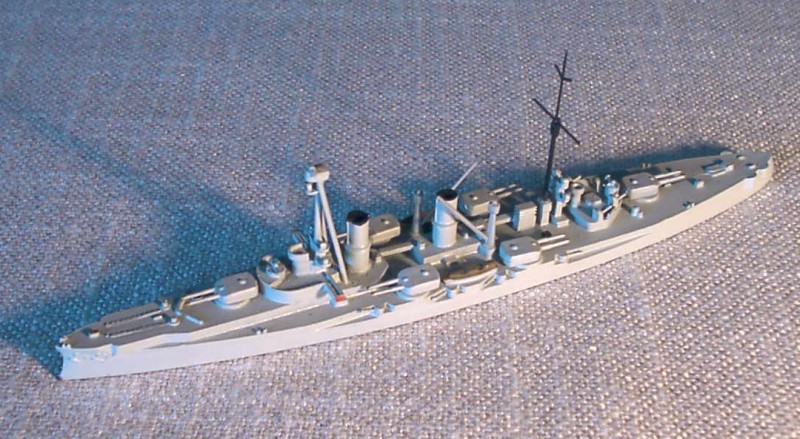
Construction record