Armored cruisers at their peak
Eight 21 cm guns, stronger armor and good endurance made the class formidable overseas flagships and the most powerful German armored cruisers of their generation.

Design and service
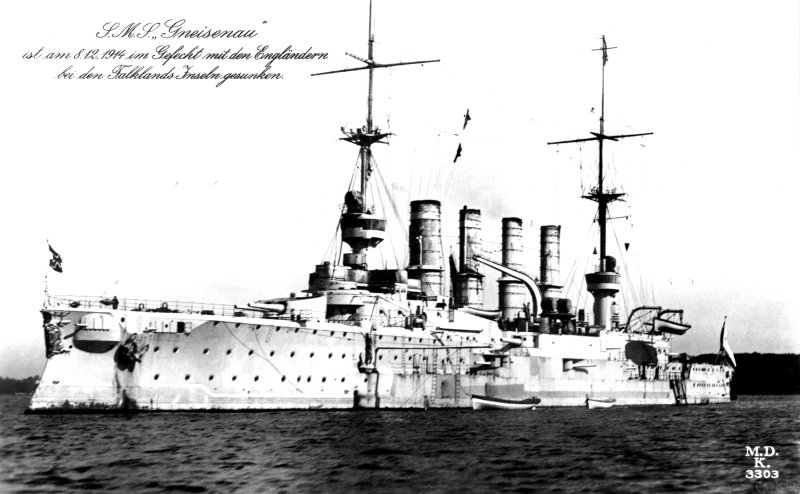
Gneisenau shared the East Asia Squadron's long escape across the Pacific and its transition from overseas force to commerce-war target.
The full story
Scharnhorst and Gneisenau were the last German armored cruisers of the old classical design, their successor, the Blücher, would mark the way to the modern battlecruiser. Being the final evolution of a series of ships, the two armored cruisers were the heaviest armed and best protected of their kind in the German fleet.
Their main armament was doubled to eight 21 cm guns, four in turrets and four in single mounting at the sides of the ship - the secondary armament had decreased because of this. The increase of armor and the enlargement of the engine system cause a massive increase of size compared to their predecessors, almost 20%. Their general layout and design was very similar to those of the Roon class giving the ships a very similar appearance.
After the construction of the British battlecruiser Invincible, the armored cruiser was outdated and not fit for fleet operations in the North Sea anymore. Therefore, both ships were sent to the East Asian cruiser squadron where they had a similar fate, taking part in two of the famous naval battles of World War I. both fought the Battle of Coronel, sinking two British armored cruisers and were sunk during the Battle of the Falkland islands five weeks later by superior British battlecruisers.
Operational history
Gneisenau is commissioned.
Training and trials.
The Gneisenau is attached to the reconnaissance forces.
Fleet exercises and voyage to the Atlantic.
Voyage to Spain.
Voyage to Norway.
The ship is sent to South East Asia to join the cruiser squadron, stationed at Tsingtau.
Stop in Malaga.
Stop in Port Said.
Stop in Colombo, Sri Lanka.
Stop in Bombay.
Stop in Yaigarth, just south of Bombay.
Stop in Cochin, India.
Stop in Colombo, Sri Lanka.
Stop in Calcutta.
Stop in Singapore.
Stop in Hong Kong.
Stop in Amoy.
Arrived in Tsingtau.
Repairs in Tsingtau
Visit to Japan.
Voyage to Indonesia.
Visit to Rabble.
Voyage to Port Arthur.
Fleet operations in South East Asian waters.
After a visit to Nagasaki, Gneisenau meets the other ships of the far east squadron at the Marianas.
The armored cruisers Scharnhorst, Gneisenau and the small cruisers Nürnberg and Leipzig make a stop at Simpson Harbor in Rabaul.
At the outbreak of the war, the far east squadron under Admiral Graf von Spee was on sea. Since Japan entered the war on Allied side, the ships could not return to their base in Tsingtau. Instead it was decided to operate in the Eastern Pacific and Southern Atlantic.
Battle of Coronel: Off the Chilean coast, the German squadron of Scharnhorst, Gneisenau and the CLs Dresden, Leipzig and Nürnberg are approached by the British armored cruisers Good Hope, Monmouth, the CL Glasgow and the auxiliary cruisers Otranto. Battle starts at 18:30 in a distance of 11000m, because of the heavy seas, only the armored cruisers were able to fire. Both British armored cruisers were sunk without survivors, while the German ships did not suffer any significant damage, but have used 42% of their ammunition. In order to refill their coal supplies, the German ships decide to raid the British base on the Falkland island
Gneisenau and the other ships pass Cape Horn.
Battle of the Falkland Islands: After a reconnaissance operation neat the British base by the Gneisenau early in the morning, the Germans knew about the British ship refueling at Port Stanley: The battlecruisers Invincible and Inflexible, the armored cruisers Carnarvon, Kent and Cornwall, two CLs and an auxiliary cruisers. Because of the superior British forces the German ships turn south, but because of their higher speed, the British ships came into battle distance by 12:50. On 13:20 the CLs Dresden, Nürnberg and Leipzig were detached and were ordered to escape, while Scharnhorst and Gneisenau would cover them. As the British 30,5 cm guns had a greater range than the German 21 cm guns, Scharnhorst and Gneisenau were destroyed without any chance, Scharnhorst sunk on 16:17, with 880 casualties. All other ships except the Dresden were sunk, too.
At a glance
Dimensions, armament, protection and performance.
The archive
Original postcard and photographic material from the private collection.
Construction record