A class shaped by overseas ambitions
Five protected cruisers combined a substantial gun battery with accommodation and endurance suited to foreign stations and training duties.
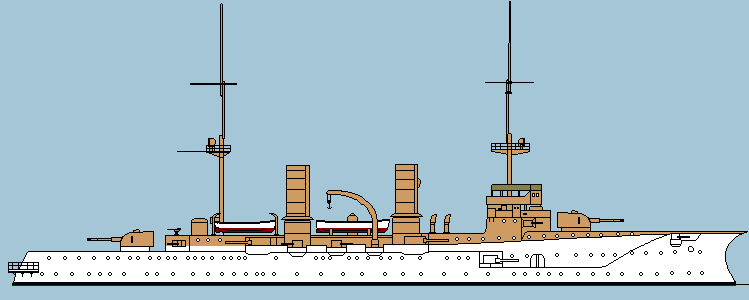
Design and service
Herta's career linked colonial-era presence, the intervention in China and the peacetime training system of the Imperial Navy.
The full story
The five protected cruisers of the Victoria Louise class, officially designated "Große Kreuzer," were intended for overseas service and fleet reconnaissance. They marked an early stage in the development that eventually produced the German battlecruisers, but several shortcomings limited their effectiveness.
Their limited range restricted overseas employment, while weak side protection made them vulnerable in combat. Hot and cramped accommodation reduced crew comfort, and their modest speed limited their usefulness with the fleet.
Despite these limitations, the ships handled well at sea, although their high hulls and superstructures made them sensitive to strong winds.
All five ships were reconstructed between 1905 and 1910. Their boilers were replaced, one funnel was removed and their operational range was increased. They subsequently served as training ships and were reactivated at the outbreak of World War I. Their limited combat value soon confined them to secondary or stationary duties. All five were scrapped in the early 1920s.
Operational history
Shipyard trials, during the return to Kiel, the ship rams the Linienschiff Baden.
Herta is commissioned.
Escort ship of the imperial yacht during its mediterranian voyage.
Sent to Genua for repairs.
The cruiser is damaged during a heavy storm.
Sent to South East Asia.
Arrival in Singapore.
Arrival in Tsingtau.
Visit to HongKong, repairs
Visit to Japan.
Excercises together with Hansa, Kaiserin Augusta, Gefion and Irene near Tsingtau.
Arrival at Taku. Troops of the Herta join the operations against the Taku Fortress.
Visit to Kobe and Nagasaki.
Repairs in Uraga.
The ship is damaged in a heavy taifun.
Repairs in Nagasaki.
Based in Tsingtau
Ordered back to Germany.
Arrived in Kiel, decommissioned.
Refits in Kiel, the ship is equipped with new boilers and different armement. It is rebuild as a training ship.
Recommissioned.
Begin of a voyage to Norway, Scotland, Ireland and the Mediterranean.
The Herta transports 20 tons of food to Messina which is badly damaged by an earthquake.
The ship heads for Neaples with 120 wounded on board.
Ordered back to Germany.
Arrival in Kiel.
Training voyage in the Baltic Sea and Norway.
Visit to Ney York, followed by a trip to the Caribic.
Arrival in Kiel.
Training voyages to Norway and the Baltic Sea.
Training voyage to the Mediterranean.
Training voyage to the Baltic Sea, Sweden and Norway.
Voyage to the West Indies.
Voyage to the Azores.
Attached to the Mediteranian Division.
Arrival in Kiel.
Repairs in Kiel.
Training voyage to Norway.
Arrival in Wilhelmshaven.
Voyage to Halixax, Mexico and the Antilles.
Last training voyage to Norway and England.
Patrol duties in the Baltic Sea.
Decommissioned in Kiel. Used as a floating barrack in Flensburg until the end of the war.
Removed from fleet lists.
Scrapped in Audorf.
At a glance
Dimensions, armament, protection and performance.
Construction record