More firepower for the scouting force
Twin 21 cm turrets and improved protection strengthened the cruiser concept while preserving the range required for fleet and overseas work.
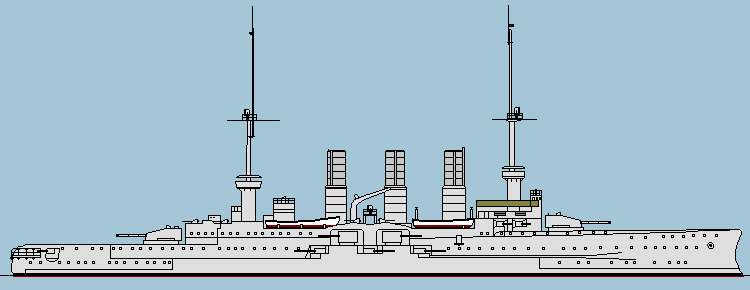
Design and service
Friedrich Carl entered war with extensive instructional service behind her and became a central unit in early Baltic operations.
The full story
After the construction of the armored cruiser Prinz Heinrich, its reduction in armament was heavily criticized. Therefore, the two ships of the following Prinz Adalbert class had the double number of heavy artillery guns, but the size had to reduced to 21 cm again in order not to increase the size of the ship.
Showing the same design principles than the previous classes, those two ships again had an increase in engine power to archive a higher top speed, but like the gun size this was limited by the restriction not to increase the ship size.
They were maneuverable and good seagoing ships, but their outward decks and casemates were flooded even by smaller waves.
Unlike other armored cruisers, both ships were lose early in the war. Friedrich Carl sank after two mine hits just three months after the outbreak of the war.
Operational history
Friedrich Carl is commissioned.
Used as escort for the passenger ship König Albert during the Spain and Mediterranean voyage of Kaiser Wilhelm II.
Attached to the reconnaissance forces of the battle fleet.
Training voyage to Dutch, English and Norwegian harbors.
Fleet exercises in North and Baltic Sea. After that the ship training and trials of the ship are completed.
Used as escort for the passenger ship Hamburg during the Mediterranean voyage of Kaiser Wilhelm II.
Summer voyage of the fleet to Sweden.
Training in Danish waters.
Decommissioned.
Recommissioned as torpedo test ship.
Used an an auxiliary ice breaker in the Baltic Sea.
Put temporarily out of service due to necessary repairs.
The ship is attached to the Baltic fleet and takes part in several operations.
The ship is hit by two mines in a mine field laid by four Russian mine layers on 05.11.1914. Although the ship was kept afloat for several hours it finally capsized. Most of the crew was rescued by the Light Cruiser Augsburg.
At a glance
Dimensions, armament, protection and performance.
The archive
Original postcard and photographic material from the private collection.
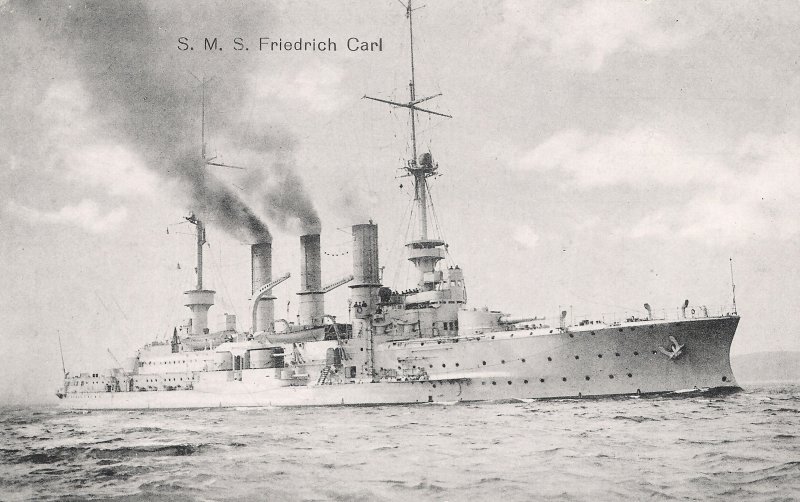
Construction record