Six heavy guns, one unusual battery
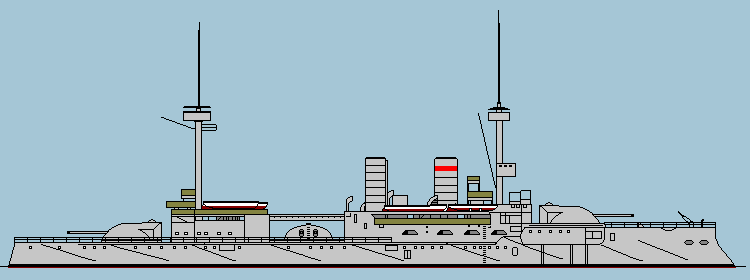
Three twin-gun turrets gave the class a powerful but unconventional centerline battery at the beginning of Germany's ocean-going battleship era.
Design and service
The four battleships (the official German designation was Linienschiff) of the Brandenburg class were the first attempt to build real battleships, in difference to their predecessors which were mainly build as coast defence ships. They were the strongest ships of the German navy when they were commissioned. Although they were quite maneuverable ships with a fast turning speed, they tend to take over much water in heavy seas, something that would be characteristically for almost all German battleships. Their 28cm guns could only be loaded in end-on position and had a slow firing rate once the ammunition stored in the turret itself was used up, the barrels of the medium turrets were shorter than those of the others because of the surrounding superstructure.
As part of the 1st Linienschiff Division, they took part in the international intervention in China after the so called "Boxer-insurrection" in 1900 and 1901.
The Brandenburg returned to fleet service after the operations in Asia and was used as a coast defence ship in 1915. From 1916-1918 it was used as a floating barrack at Libau and it was planned to rebuild it as a target ship. This project was canceled and the ship was scrapped in 1920.
Operational history
Brandenburg is commissioned.
First trials with Kaiser Wilhelm II on board.
During high speed trials, a steam line explodes in the engine room, killing 44 crew members.
Repairs.
Attached to the 2nd Division of the Manouversqadron.
Maneuvers in the North and Baltic Sea.
Collision with the armored ship Würtemberg, both ships were damaged and had to be repaired.
Training in the North Sea.
Together with the other ships of the 2nd Squadron, the Brandenburg is sent to South-East Asia.
Repairs in Hong Kong.
Sent back to Germany.
Arrival in Wilhelmshaven.
Fleet services and exercises.
Decommissioned.
Modernization and refits at the Kaiserliche Weft, Wilhelmshaven.
Recommissioned, used for fleet operations.
Decommissioned, put into fleet reserve.
Recommissioned, used as a training ship.
Decommissioned.
After the outbreak of World War I, the Brandenburg is attached to the 5th Squadron, used for coast defence duties in the North Sea.
Sent to the eastern Baltic Sea.
Again used for coast defence in the North Sea.
Decommissioned, used as a floating barrack in Libau. The main guns were removed and were ordered to sent to Turkey, but this was never done.
After the war, the ship was transferred to Danzig where it was paned to rebuild it as a target ship.
Reconstruction stopped, removed from fleet lists.
Scrapped in Danzig.
At a glance
Dimensions, armament, protection and performance.
Construction record