Built under the Naval Laws
The class translated Germany's expanding naval program into five balanced pre-dreadnoughts intended for concentrated service with the battle fleet.
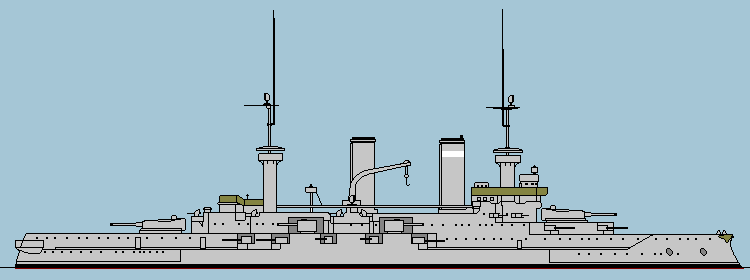
Design and service
The Wittelsbach class formed part of the major German fleet-building program begun in the final years of the 19th century. Similar in armament and armor protection to the preceding Kaiser Friedrich III class, these ships and their immediate successors formed the core of the German battle fleet until the arrival of the Nassau-class dreadnoughts in 1909.
The very maneuverable ships were already outdated at the outbreak of World War I and were actively used only in the first years. Until 1916, all five were used for fleet services, Schwaben was mainly used as artillery training ship up to 1911 when the Wettin took over this role until 1914. In 1916, all of them were removed from active fleet service. Until 1920, the Zähringen was used as a training ship and then laid down as a hulk for six years. In 1926 it was converted into a remote controlled target ship and used in this role unit 1944 when it burned out on 18.12.1944. On 26.03.1945 the wreck was scuttled and broken down in 1949 and 1950.
Operational history
Zähringen is commissioned.
Training and trials.
The ship is used for ice emergency duties in the western Baltic Sea.
Used for fleet services.
Decommissioned. The ship is assigned to the Baltic Reserve Division.
Recommissioned, transferred to Kiel.
Decommissioned.
Recommissioned.
During a fleet maneuver, the Zähringen rams the torpedo boat G171 which sinks after the collision.
Decommissioned.
With the outbreak of World War I, the Zähringen is recommissioned and attached to the 4th Squadron.
Operations in the Baltic Sea to assist the beached cruiser Magdeburg.
Operations in the Baltic Sea.
Operations in the Baltic Sea.
Patrol duty in the North Sea.
Patrol duty in the North Sea.
Operations near Gotland.
Operations near Gotland.
Sent back to Kiel, used as target ship for the torpedo inspection.
Reconstruction to cadet training ship. Modification stopped at the end of the war.
Decommissioned.
Zähringen is modified to a radio controlled target ship. All guns are removed and 1700 tons of cork are installed in the ship. After the modification, the ship is only able to reach 13 knots.
First usage as a artillery target ship.
Used as a target ship for other Kriegsmarine ships.
Sunk after an air attack on Gotenhafen (Gdynia) in shallow waters.
Sunk as a blokade ship at Gotenhafen (Gdynia) harbor entrance.
Wreck raised and scrapped.
At a glance
Dimensions, armament, protection and performance.
The archive
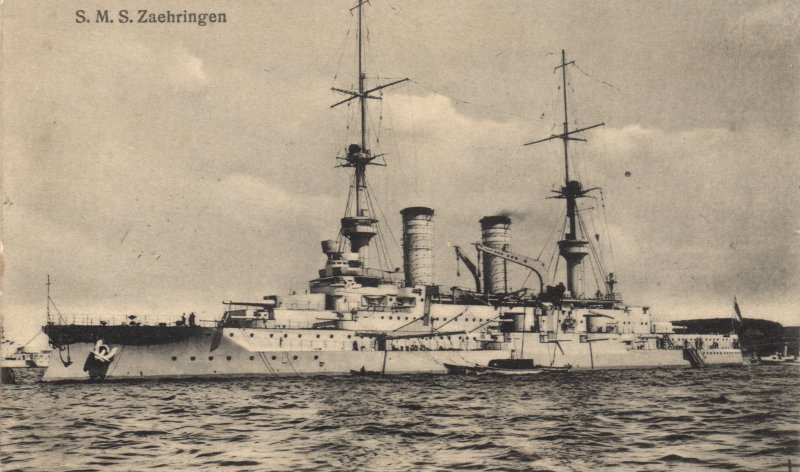
Original postcard and photographic material from the private collection.
Construction record