Heavier guns for the pre-dreadnought fleet
A 28 cm main battery and powerful 17 cm secondary armament made the class a substantial advance over its immediate predecessors.
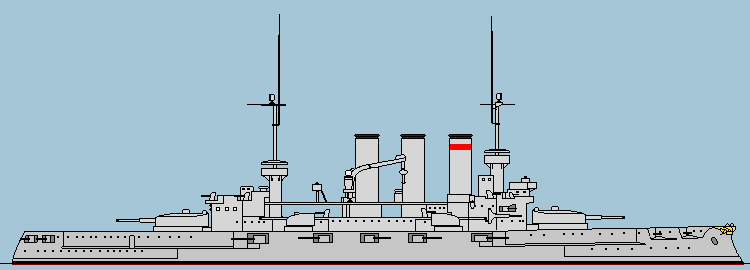
Design and service
Compared to the older German battleships, the five ships of the Braunschweig class showed a improvement mainly in the artillery component. The main artillery grew to 28 cm guns while for the first time 17 cm guns were used as secondary artillery. Being maneuverable and good seagoing ship, they tend to roll in heavy seas, bud did not take over much water as it was common for other German ships of this era.
Like their follow ups, the Deutschland class, those ships were obsolete at the outbreak of the war and their active duty was limited to coastal defence only. They were among the few old battleships that Germany was allowed to keep after World War One and they were actively used by the Reichsmarine until the mid 1930.
The Braunschweig was used for fleet service until July of 1916 when it was reclassified as a floating barrack. Between 1921 and 1926 it was used for fleet service in the Reichsmarine and broken down in 1931. Its sister ship Elsass had a quite similar fate, its active duty in the Reichsmarine was between 1924 and 1930 and it was broken down in 1936.
Operational history
Elsass is commissioned.
During the trials, the rudder is damaged.
Repairs.
Squadron operation in the North and Baltic Sea.
Summer voyage of the fleet, including visits to Göteborg and Stockholm.
Collision with the artillery training ship Schwaben, both ships are slightly damaged.
Fleet operations in the Baltic Sea.
Elsass takes part in all fleet exercises and operations.
An exploding grenade kills 3 crew members, 6 others are wounded.
Summer voyage to the North Atlantic, including a visit to Las Palmas.
Summer voyage to the North Atlantic, including a visit to El Ferrol.
Used for coastal defenses in the North Sea.
The ship is attached to the 1st Squadron.
During exercises in the North Sea, the Elsass rams the Swedish steamer Pollux which sinks after the collision.
Used as a target ship for the Blücher near the Faroers Islands.
Removed form the 1st Squadron, crew is reduced.
Attached to the 5th Division.
Exercises in the North and Baltic Sea.
Decommissioned, transferred to the Baltic Sea.
Recommissioned and attached to the 4th Squadron.
Together with the Roon, Prinz Adalbert and Gazelle, the Elsass is sent to assist the beached cruiser Magdeburg. After the destruction of the small cruiser, the operation is cancelled.
Operation in the eastern Baltic Sea.
Patrols at the Elbe estuary.
Repairs.
Sent to the Baltic Sea.
Repairs in Kiel.
Again sent to the North Sea, patrols at the Elbe estuary.
Sent to the Baltic Sea.
Operations in the eastern Baltic Sea.
Operations in the eastern Baltic Sea, collision with the torpedo boat G175.
Short engagement with the Russian battleship Slava.
Because of crew shortages, the crew of the Elsass is reduced.
Used as stationary training ship in Kiel.
Decommissioned.
Recommissioned with reduced armament.
Visit to Vigo.
Visit to Oslo.
Visit to Odde.
Exercises in the Atlantic and Mediterranean.
Exercises in the Atlantic and Mediterranean.
Because of the cold winter, the Elsass is used as a Ice-breaker in the Baltic Sea.
Decommissioned.
Ship is scrapped.
At a glance
Dimensions, armament, protection and performance.
Construction record