A larger dreadnought battery
Twelve 30.5 cm guns gave the class a marked increase in firepower while retaining the broad hexagonal turret arrangement of the Nassau design.
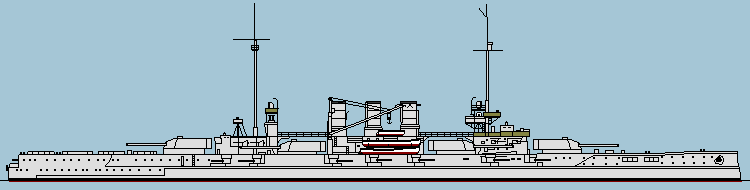
Design and service
The battleships of the Helgoland class were the last German battleships with steam expansion engines and build as replacements for old armored ships and coast defense ships. Although it was considered to use steam turbines for the next battleships after the Nassau class, the development of turbines did not reach the state to produce powerful and reliable turbines for such ships.
As a result of this, those ships were basically enlarged ships of the Nassau class, with the same hexagonal positions of the main artillery turrets. This was not without contradiction in the German navy since only 2/3rd of the 30,5 cm guns could be used for broadside fire. In addition to the enhanced gun size - it grew from 28 cm to 30,5 cm -, the internal subdivision and armor protection were also improved.
All four ships served in the 1st Battleship Squadron of the Imperial Navy and took part in all major fleet operations. They were only lightly damaged during the Battle of Jutland and were not interned at Scapa Flow unlike most other Imperial Navy ships. All expect the Ostfriesland were scrapped after the war, while the Ostfriesland had an unique fate: It was the first battleship that was sunk by aircraft during weapons tests in the USA in 1921.
Operational history
Shipyard trials.
Helgoland is commissioned.
End of trials and ship is put into active duty.
Attached to the 1st Battleship Squadron in Wilhelmshaven.
Fleet excercises in the North Sea.
Fleet excercises in the North Sea.
Part of the 1st Battleship Squadron at the outbreak of the war.
Operations at the Hoofoten.
Covers battlecruisers during coastal bombardment of Yarmouth.
Covers battlecruisers during coastal bombardment of Scarborough.
Operations in the eastern Baltic Sea.
Covers battlecruiser coastal bombardment of Yarmouth and Lowestoft.
Battle of Jutland: Helgoland is hit once. During the nicht battle, the ship engages several British destroyers.
Repairs at Kaiserliche Werft in Wilhelmshaven
Unsuccessful North Sea Raid.
Unsuccessful North Sea Raid.
While leaving Wilhelmshaven, the Helgoland ramms the battlecruiser Hindenburg which is colose to completion. The Hindenburg is lightly damaged.
Together with the Oldenburg, the battleship covers the returning mine cruisers Brummer and Bremse.
Sent into the Baltic Sea.
Returned to the North Sea.
Unsuccessful raid in the northern North Sea at the area of Stavanger.
Sent to Harwich to take over and return the crew of U-Boats which had to be delivered to Britain.
Decommissioned
Striken from fleet lists.
Taken over by Britain in replacement of the ships scuttled at Scapa Flow as ship K.
Scrapped at Morecambe after several tests.
At a glance
Dimensions, armament, protection and performance.
Construction record