Germany enters the dreadnought age
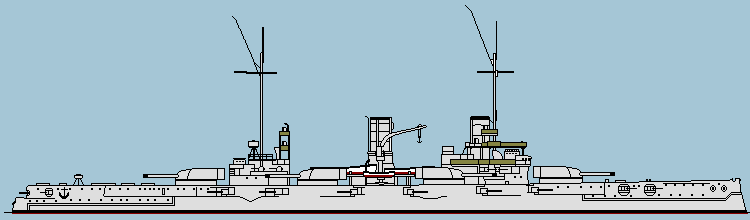
Six twin 28 cm turrets in a hexagonal arrangement made the class Germany's first answer to the all-big-gun battleship revolution.
Design and service
At the beginning of the 20th century, the German Imperial Navy was in the process of enlarging its fleet with a great number of ships, which were all modern to that days technical standard. But with the introduction of the "All-big-gun-battleship", the British Dreadnought, even the newest ship got obsolete from on day to another, since the steam turbine powered, one caliber battleships was one step ahead of the common multiple caliber warships.
As a reaction to this, the latest German battleships under development - a 14000 t ship with 30,5 cm an 24 cm guns - was modified to match the new British design. enlarged ot 19000 t with twelve 28 cm guns mounted in "Hexagonal" positions, but still with expansion engines instead of turbines, the Nassau class was the first class of "All-big-gun-battleships" of the Imperial Navy.
Although they seemed to be a bit more conservative than contemporary British deigns, they had a much better internal protection, giving the ships a much better chance to survive even heavy damage as it was proven in several occasions.
All four ships of this class were part of the 1st Battleship Squadron and shared a quite similar operational live. All took part in the battle of Jutland and besides the Rheinland, which run aground in 1918 and was very difficult to get afloat again, the other ships were taken over by other countries after the war and scrapped in the early 1920s.
Operational history
Westfalen is commissioned.
Training and trials. After that the ship is attached to the 1st Squadron.
Flagship of the 1st Squadron.
Part of the 1rd Battleship Squadron at the outbreak of the war.
Operations at the Hoofoten.
Covers battlecruiser coastal bombardment of Yarmouth and Lowestoft.
Battle of Jutland: Westfalen is hit once.
Repairs.
Unsuccessful North Sea Raid. Torpedoed by British submarine E23.
Repairs.
Unsuccessful North Sea Raid.
Westfalen takes part in operations to free Finland.
Used as artillery training ship.
Decommissioned.
Taken over by Britain as ship D.
Scrapped at Birkenhead.
At a glance
Dimensions, armament, protection and performance.
The archive
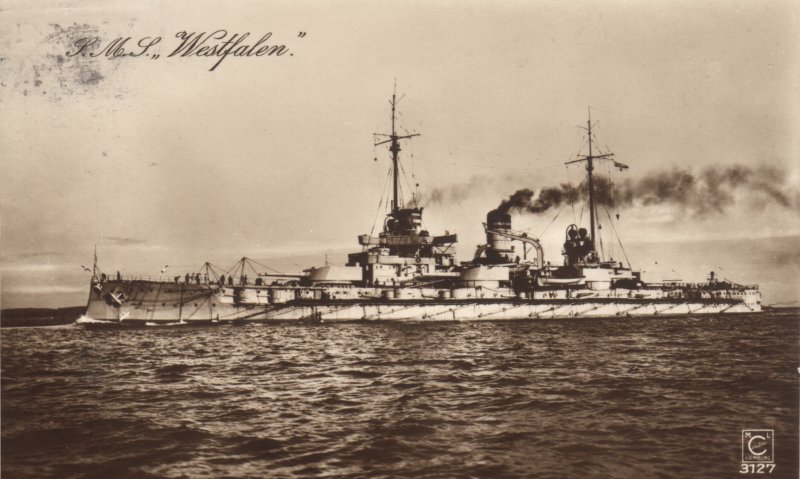
Original postcard and photographic material from the private collection.
Construction record