Heavy guns on the centerline
Five twin 30.5 cm turrets on the centerline improved firing arcs and made the class the fleet's most powerful ships at Jutland.
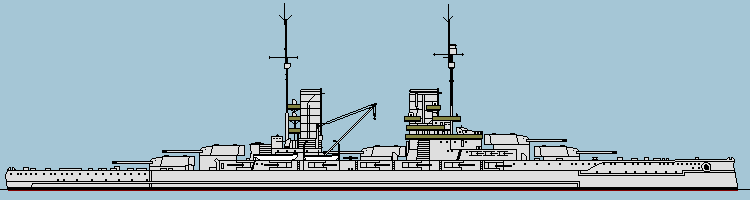
Design and service
The König class was the successor of the Kaiser class and although there were several similarities between them (like the size of the main artillery), the König class showed several improvements, especially in the engine system. For the first time, a mixed boiler system was used - 3 oil fired boilers and 12 coal fired. The initial plans for those ships were even more ambitious - the center shaft was planed to be driven by a diesel engine of 12000 hp, giving the ships a speed of 12 kn with the diesel engine only. But since it was not possible to build such powerful diesel engines in time (the most powerful diesel had only 2000 hp), the center shaft was driven by steam turbines, too.
Also for the first time, all main turrets were put un the centerline, giving them all an optimal firing arc.
All four ships were just completed before the war and formed the 3rd Battleship Squadron of the Imperial Navy. They were the most powerful German battleships at the famous Battle of Jutland, and all four took some heavy hits during this battle, but survived. Their fate was similar to most German warships in World War I - they were scuttled at Scapa Flow, all but one still rest there today.
Operational history
Operations at the Hoofoten.
Covers battlecruiser coastal bombardment of Yarmouth and Lowestoft.
Battle of Jutland: Markgraf is hit 5 times
Repairs at AG "Vulcan" in Hamburg.
Raid against the British East Coast.
Operation in the Doggerbank area.
Operation at the Danish West Coast.
Operations at the Baltic Island.
Unsuccessful raid in the northern North Sea.
Interned at Scapa Flow.
Scuttled by own crew.
Wreck sold for scrapping, but wreck is still there today.
At a glance
Dimensions, armament, protection and performance.
Construction record