The final pre-dreadnought design
Completed as HMS Dreadnought changed naval warfare, the class entered service already overshadowed by a new generation of capital ships.
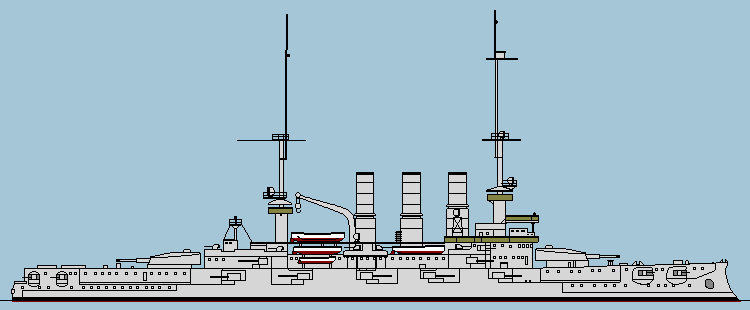
Design and service
The five ships of the Deutschland class were the last pre-Dreadnougth battleships build in Germany. Based on the previous Braunschweig class, the new ships were slightly better protected, but lost a bit of the good maneuverability. The artillery of those ships was kept quite similar to the one of their predescessors.
With their old fashioned design, those ships were only use as second line battleships during World War I, but all took part in the Battle of Jutland. Because of their age those ships were among the few battleships, Germany was allowed to keep after World War I, two of them even saw action in World War II. For more information on this, see the Kriegsmarine page about Schleswig Holstein and Schlesien.
The Deutschland was used as fleet flagship until 1913. It took part in the Battle of Jutland and was used as a barrack ship since 1917. In 1920 it was stricken from fleet lists and broken down between 1920 and 1922 in Wilhelmshaven.
Operational history
Deutschland is commissioned.
Tests and trials.
Attached to the 2nd Battleship Squadron, flagship of the Hochseeflotte.
Maneuvers in the North Sea.
Maneuvers in the North Sea.
Autumn fleet maneuvers.
Repairs and refits.
Fleet exercises in the Baltic Sea.
Operations near Helgoland.
Fleet exercises in the North Atlantic.
Autumn fleet maneuvers.
Maneuvers in the North Sea.
Fleet exercises in the North Atlantic.
Autumn fleet maneuvers.
Voyage to Norway.
Training and exercises in the North Sea.
Voyage to Norway.
Autumn fleet maneuvers in the Baltic Sea.
End of service as fleet flagship.
Repairs and refits.
Operation near Bornholm.
Used for Patrol and coast defence duties.
Participation in the Battle of Jutland.
Patrols and coast defence duties.
Decommissioned, used as a floating barrack.
Deutschland is stricken form fleet lists.
Scrapped in Wilhelmshaven.
At a glance
Dimensions, armament, protection and performance.
Construction record