The foundation of the small-cruiser line
Ten compact cruisers established the combination of overseas range, fleet scouting ability and quick-firing guns developed by every following class.
The full story
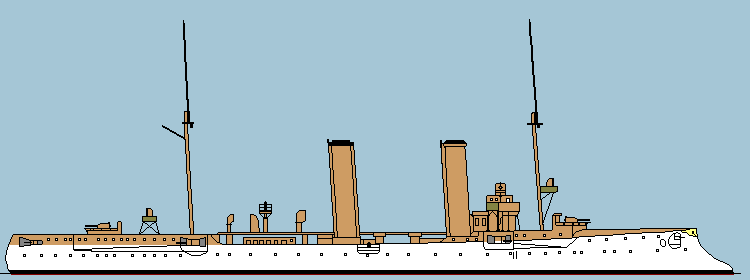
The Gazelle class comprised the first modern small cruisers built for the Imperial German Navy. The design began a line of development that culminated in Emden, the first German cruiser completed after World War I. With ten ships, the Gazelles were also the largest class of German small cruisers. Because construction extended from 1897 to 1904, individual ships differed in dimensions and appearance as the design evolved.
The Gazelle class introduced the 10.5 cm gun as the standard weapon for German small cruisers. This caliber remained in service even as British cruisers adopted heavier main batteries.
Already obsolete by 1914, the ships served primarily in coastal defense during World War I. Several were lost, while the survivors performed various duties after the war. None was interned at Scapa Flow. Two survivors were later converted into floating antiaircraft batteries during World War II.
The Arcona operated in foreign waters until 1910. In 1913 it was used as an experimental mine ship, during WW1 it operated as mine cruiser and coastal defence. Between 1919-1920 it was used for minesweeping operations in the North Ssa, followed by three years of service in the Reichsmarine. Until its conversion into a floating AA battery it was used as a floating barrack. It was sunk on the same day like the Medusa.
Operational history
Arcona is commissioned
Attached to the reconnaissance forces.
Participation in the autumn maneuvers.
Fleet parade in Great Britain for King Eduard VII.
Summer voyage with the battlefleet to England, the Netherlands, the Shetland Islands and Norway. Arcona is detached to Aberdeen to receive mail bags.
Summer voyage to Sweden.
Summer voyage to Norway.
Excercises with the reconnaisance forces.
Decommissioned
Arcona is prepared to be uses on foreign stations and refitted and repainted in Wilhelmshaven.
Send to East-Asia.
Arrival in Singapore.
Visit to Japan.
Voyage across the Celebes Sea.
Sent to Samoa because of the uprising there.
Return to Tsingtau.
Sent to San Francisco as German representation at the 140. anniversary of the discrovery of San Francisco beight. The trip included stops in Honolulu, Seatle, San Pedro, Los Angeles and San Diego.
Ordered back to Germany
Arival in Wilhelmshaven.
Decommissioned.
Reconstruction as mine cruiser, two 10,5 cm guns are removed. The ship is capable of carrying 200 mines.
Recommissioned, the crew was taken from the mine cruiser Nautilus. The ship is attached to the mine experimental commission.
Participations in the autumn exercises.
With the outbreak of the war, the two 10,5 cm guns are reinstalled and the ship becomes flagship of the coastal division Ems.
Mothership for UZ-Boats, in replacement of the old Linienschiff Preußen. Reconstruction in the Reichswerft Wilhelmshaven, all guns were removed.
Decommissioned and modernized and rearmed as cruiser for training purposes again.
Commissioned and attached to the North Sea forces.
Visit to Arendal, Norway.
Ice emergency services in the western Balitc Sea, the Arcona is damaged and has to be repaired.
Visit to Balholmen.
Visit to Abo and Karlskrona
Decommissioned and put into fleet reserve.
Striken from the list of warships, used as floating barrack in Wilhelmshaven, Swinemünde and Kiel.
Reconstructed as floating AA battery at Deutsche Werke Kiel, moved to Wilhelmshaven.
Scuttled by its own crew.
Scrapped.
At a glance
Dimensions, armament, protection and performance.
The archive
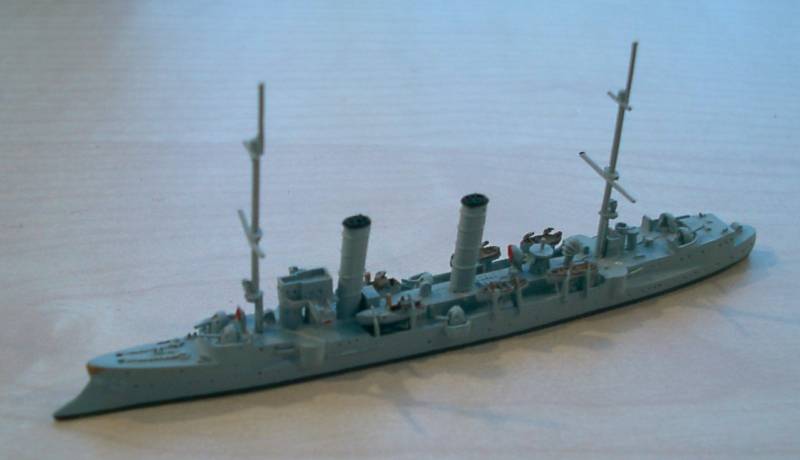
Ship models in 1/1250 scale.
Construction record