More speed and a heavier broadside
Four larger turbine cruisers strengthened the scouting force and entered war as active units in the North Sea and Baltic.
The full story
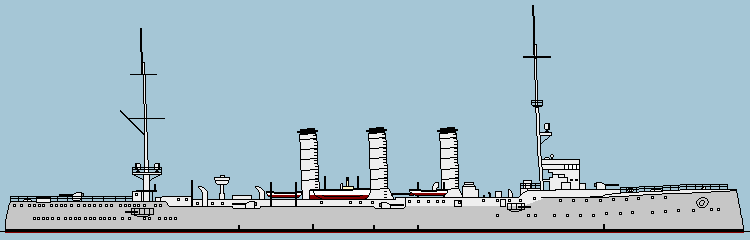
The small cruisers of the Kolberg class were significant bigger than their predecessor, enabling to add two additional 10,5 cm guns to the ships. All four ships had different kind of turbines to find the best of them for later cruiser designs: Melms & Pfenninger (Kolberg), Parsons (Augsburg), Schneider-Zoelly (Cöln) and AEG-Curtis (Mainz). Those installed in the Cöln proofed to be very unreliable therefore they were exchanged with Germania-turbines after trials.
Like many other small cruisers, their main armament was replaced during the war, the twelve 10,5 cm guns were replaced with six 15 cm guns. They were good seagoing ships, but had a bad maneuverability.
Cöln and Mainz were both sunk in the Battle of Helgoland where the German reconnaissance forces were attacked by British battlecruisers. Cöln was flagship of the torpedo boats and attacked the British cruiser Fearless in this battle until it was heavily shelled and sunk by the British battlecruisers Lion and Princess Royal, with all but one of the crew lost. In August of 1979 the wreck was moved to a nearby location at the bottom of the North Sea.
Operational history
Commissioned.
Participation in fleet parade.
Attached to the reconnaissance forces.
Cöln takes part in all exercises and voyages of the Hochseeflotte.
Torpedo exercises in Norwegian waters.
During the autumn fleet maneuver, Cöln tries to warn the first German naval airship about bad weather. Communications fail and the airship were lost.
Coastal defence in the German Beight.
Fleet operation with torpedoboats and the small cruiser Hamburg.
Another fleet operation with torpedoboats in the North Sea.
Battle of Helgoland: Together with the small cruiser Mainz, the Cöln tries to intercept British ships near Helgoland. Both ships engage the British cruiser Arethusa and 6 destroyers, when six British battlecruisers came into sight and attacked the German ships. Cöln was destroyed by gunfire and sunk at 14:35, only one crew member survived.
At a glance
Dimensions, armament, protection and performance.
The archive
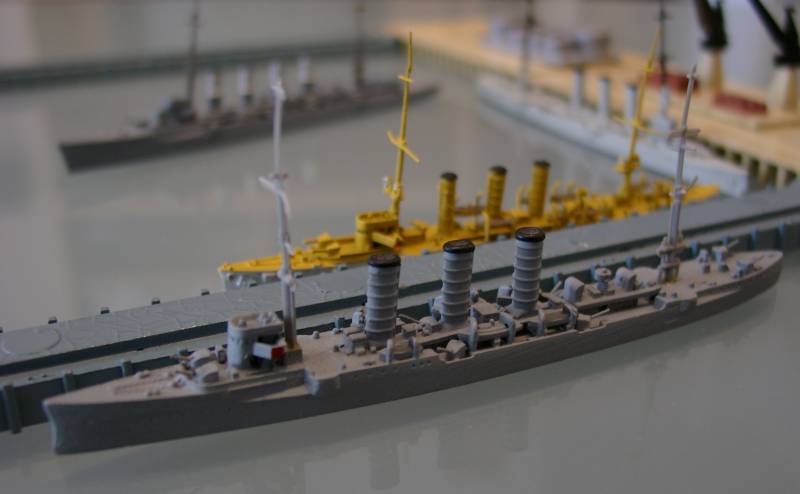
Ship models in 1/1250 scale.
Construction record