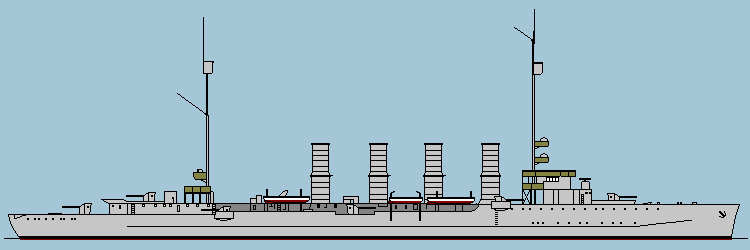
A modern wartime silhouette
A longer forecastle, belt armor and improved subdivision created a robust class suited to aggressive fleet reconnaissance.
The full story
Besides a much more modern outer appearance then their predecessors (no "ram-bow" anymore), the four small cruisers of the Magdeburg class introduced a new feature to German small cruisers: An armor belt. This was archived with the cost of a thinner armor deck, despite the fact that the offensive capabilities were not increased. Like on other small cruisers, the 10,5 cm guns were replaced by 15 cm guns after the outbreak of World War I. The ships were said to be very bad seagoing s and tent to produce huge vibrations at speed above 22 knots. The engine rooms were very cramped, making maintenance difficult.
The Breslau was part of the Mediterranean Division, together with the battlecruiser Goeben. Together with the battlecruiser, the Breslau then served under Turkish command, although the crew was still German. Given the nickname "Plaemyannik" - the nephew - by the Russians, it operated together with the Goeben against Russian forces until it sunk on 20.01.1918 after five mine hits.
Operational history
Breslau is commissioned.
Attached to the reconnaissance forces of the Hochseeflotte.
Used as an escort vessel to the imperial yacht Hohenzollern during a voyage to Norway.
Assigned to the Mediterranean Squadron and sent to the Mediterranean Sea.
Part of the international blockade of the coast of Montenegro.
Sent to Constantinopel.
Repairs at Trieste.
Joins the battlecruiser Goeben near Corfu.
Operations against French troop transports in the Mediterranean.
Coastal bombardment of Bona.
Visit to Messina.
Engagement with the British cruiser Glouchester. Breslau is hit once but not damaged.
Arrived at the Dardanelles.
Breslau is put under Turkish command and renamed to Midilli. The German crew stays on board and the ship is still commanded by its German commander.
Operations against Russians ships and bases in the Black Sea. 60 mines are laid near the Kerch strait, causing the loss of two Russian merchant ships. Together with the Turkish torpedo cruiser Berk, Novorossiik is shelled.
Operations against Russians ships and bases in the Black Sea, coastal bombardment of Poti.
Battle of the Cape Sarych-. Together with the Goeben, Breslau engages 5 Russian battleships.
Operations against Russians ships and bases in the Black Sea, including a battle against the Russian battleship Rostislav. at dawn of the 24th, Breslau engages the Russian steamer Atos.
Operation with the Turkish cruiser Hamidieh, pursuit by the Russian cruisers Kagul and Pamiat' Merkuria.
Another Operation with the Turkish cruiser Hamidieh, again pursuit by the Russian cruisers Kagul and Pamiat' Merkuria.
Repairs.
Coastal bombardment of Thedosia.
Operation together with the battlecruiser Goeben, sinking two Russian merchant ships.
Breslau is attacked by the Russian submarine Tyulen, but not hit. In the following battle against the Russian torpedo boats Gnevny and Derzky, Breslau is hit three times.
While escorting some coal transports, the Breslau is hit by mine laid by the Russian submarine Krab.
Repairs, two 10,5 cm guns are replaced with 15 cm guns.
Battle against Russian torpedoboats Pronzielny and Bezpooiny.
Battle against Russian torpedoboats Gnevny and Schastilvy.
Pursuit by the Russian battleship Imperatrisa Ekaterina Velikaya, some minor damages on the Breslau.
Laid a mine field off Fidonisi Island.
Coastal bombardment of Eupatoria, laid another mine field off Sevastopol.
Coastal bombardment of Tuapse and Sochi.
Breslau is surprised by the Russian battleship Imperatrisa Marie, the cruiser Kagul and the torpedo boats Schastilvy, Derzky, Gnevny, Bezpokoiny and Pylkiy. The cruiser was able to escape because of the weather conditions.
All remaining 10,5 cm guns are replaced with 15 cm guns, a additional oil firing is added to the boilers.
Laid a minefield off Fidonisi island and destroys the lighthouse and telegraph station there.
After a mine operation, the Breslau is encountered by the Russian battleship Svobodnaya Rossoya and the torpedoboats Gnevny and Schastilvy.
Together with the Goeben, the Breslau is sent into the Aegean Sea and sinks two British monitors.
After hit by five mines, the Breslau sinks near the Island of Imbros. 330 member of the crew die.
At a glance
Dimensions, armament, protection and performance.
The archive
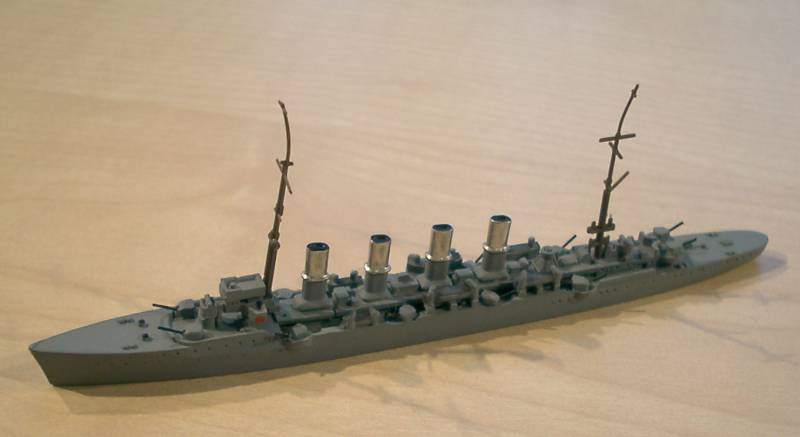
Ship models in 1/1250 scale.
Construction record