A modern wartime silhouette
A longer forecastle, belt armor and improved subdivision created a robust class suited to aggressive fleet reconnaissance.
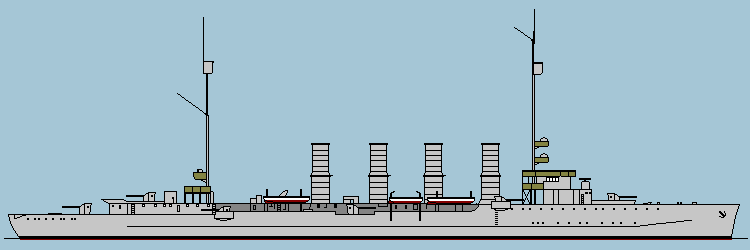
The full story
Besides a much more modern outer appearance then their predecessors (no "ram-bow" anymore), the four small cruisers of the Magdeburg class introduced a new feature to German small cruisers: An armor belt. This was archived with the cost of a thinner armor deck, despite the fact that the offensive capabilities were not increased. Like on other small cruisers, the 10,5 cm guns were replaced by 15 cm guns after the outbreak of World War I. The ships were said to be very bad seagoing s and tent to produce huge vibrations at speed above 22 knots. The engine rooms were very cramped, making maintenance difficult.
The Straßburg was first used for overseas services in 1913 and 1914 and took part in the same operation as the Stralsund. It operated in the Baltic Sea for the rest of the war, and was delivered ot Italy in 1920. Renamed to Taranto it was still operational at the Italian capitulation in World War 2- Scuttled by its Italian crew on 09.09.1943 it was raised by the Germans, sunk by bombs, raised again and sunk a third time. The ship was broken up in 1946/47.
At a glance
Dimensions, armament, protection and performance.
Construction record